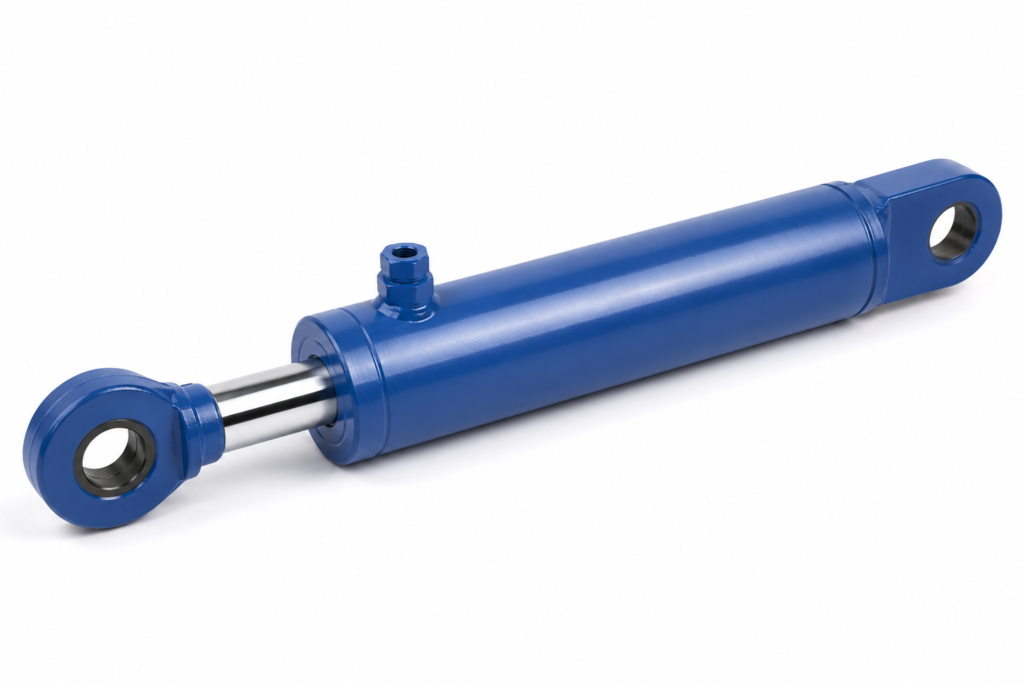
Why do engineering buyers misselect single-acting cylinders?
The most expensive mistake is treating a single-acting cylinder as a lower-cost substitute for a double-acting cylinder when the return stroke must be controlled. If the load, spring, or machine geometry cannot bring the rod back safely and predictably, the cylinder may drift, stall, chatter, or create a pinch-point hazard.
For an engineering buyer, the question is not simply whether the cylinder can lift the load. The better question is whether the return force is reliable under the worst realistic condition: cold oil, worn seals, side load, contaminated guides, uneven payload, or a tilted machine frame. This article focuses on the decision logic behind single-acting hydraulic cylinder working, especially spring return, gravity return, oil ports, real equipment uses, and selection risks before procurement.
A practical rule is clear: if the return motion comes naturally from gravity or a designed spring, a single-acting cylinder may be the efficient choice. If the machine needs powered retract, metered return speed, horizontal push-pull movement, or active holding in both directions, specify a double-acting cylinder instead.
How does a single-acting hydraulic cylinder work?
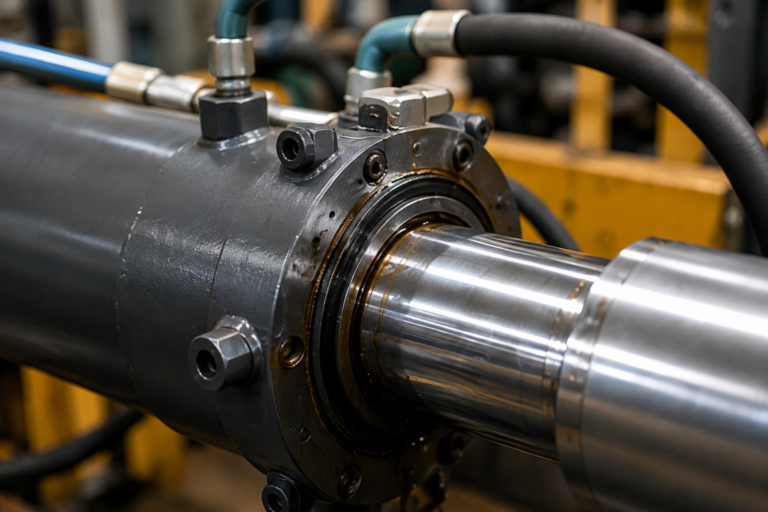
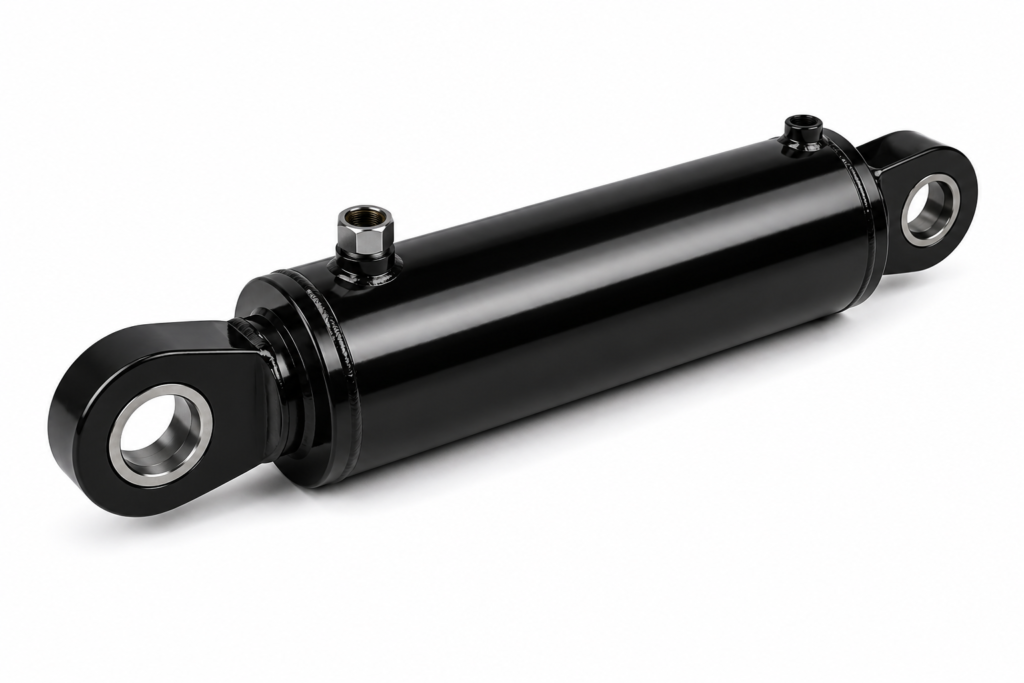
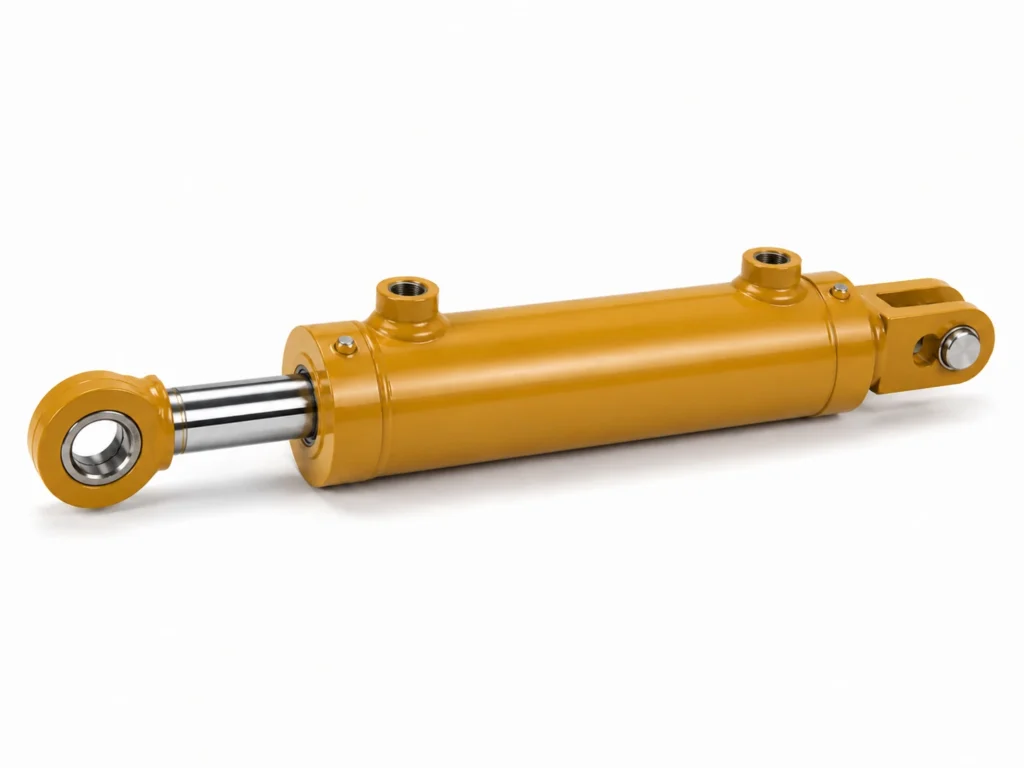
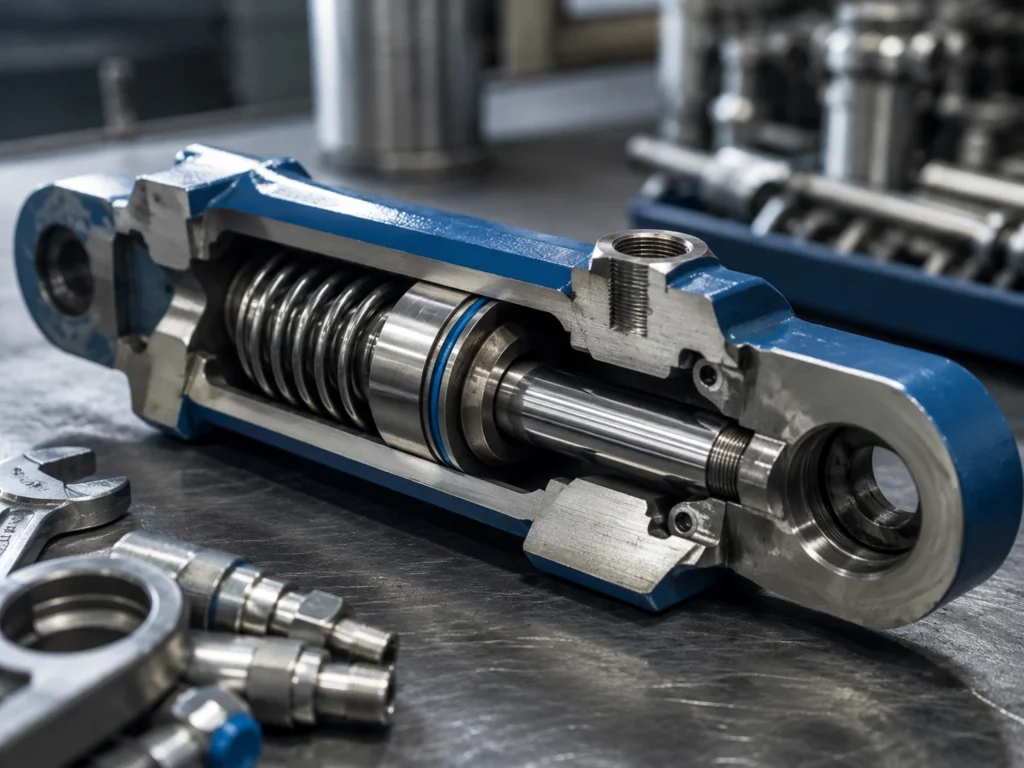
A single-acting hydraulic cylinder works by sending pressurized oil into one chamber through one pressure port, forcing the piston and rod to extend or retract in only one powered direction. The opposite movement is created by a spring, gravity, machine weight, or an external mechanical force.
In the common push-type design, the pump delivers oil into the cap-end chamber. Oil pressure acts on the piston area, generating a linear force that extends the rod. When the directional valve shifts to release oil back to tank, the return force pushes oil out of the same port, and the rod retracts.
This is why a single-acting design is often called a one-way hydraulic cylinder. The hydraulic system powers one movement; the machine or spring completes the other. ISO 5598:2020 defines fluid power vocabulary around pressure, flow, actuator, cylinder, and return concepts, which is useful when engineering teams align drawings, specifications, and supplier quotations.
Single-acting cylinders usually have simpler plumbing than double-acting cylinders. Fewer hoses, fewer valve paths, and fewer sealing interfaces can reduce installation complexity. However, simplicity does not remove the need for correct bore sizing, rod buckling checks, end mounting alignment, pressure rating verification, and return-force validation.
- Oil port
- The hydraulic connection where pressurized oil enters and exits the working chamber. Most single acting cylinders have one main pressure port.
- Spring return
- A return method where an internal or external spring moves the rod back after hydraulic pressure is released.
- Gravity return
- A return method where the weight of the load or machine structure forces oil back to tank when pressure is relieved.
- Double acting cylinder
- A cylinder with hydraulic pressure available in both extend and retract directions, normally using two ports and a directional control valve.
Key Takeaways
- A single acting cylinder is hydraulically powered in one direction and returned by spring, gravity, or external force.
- Choose single acting when the return stroke is naturally driven and does not require active hydraulic control.
- Choose double acting when return speed, return force, or bidirectional holding must be controlled by oil pressure.
- ISO 4413:2010 is the key safety reference for hydraulic system design, unintended movement, and risk reduction.
- Procurement should verify bore, stroke, pressure rating, mounting, seal material, rod buckling, and return-force margin before ordering.
Spring return or gravity return: which design should you choose?
Choose spring return for light-duty, short-stroke, repeatable return where machine weight is unavailable or inconsistent. Choose gravity return when the equipment itself provides a reliable load path, such as dump trailers, lift tables, hoists, and vertical lifting frames. Do not use either method for precision powered retract.
When spring return is the better choice
Spring return is useful when the cylinder must retract after pressure release even without an external load. Examples include small presses, jigs, fixtures, clamping devices, and service tools. The spring must overcome seal friction, oil back pressure, contamination drag, and any linkage resistance, not just the bare piston movement.
The limitation is stored energy and stroke length. A longer stroke requires a longer spring or a higher spring rate, which can increase package size and reduce net extend force. In compact equipment, spring return is best for controlled short travel, not heavy guided retraction.
Best for: fixtures, small tools, short-stroke clamps, and maintenance equipment where automatic return is needed but powered retract is unnecessary.
When gravity return is the better choice
Gravity return is common when the cylinder lifts a load and the load naturally lowers the mechanism after pressure is released. The cylinder does not pull the equipment down; it allows oil to leave the chamber while weight pushes the rod back. This is a common logic behind many single acting cylinder uses in mobile and material-handling equipment.
The risk is that gravity is not always stable. A light or empty dump body, a sticky pivot, cold hydraulic oil, a bent guide, or uneven cargo may slow or interrupt return. If a safety function depends on a guaranteed retract stroke, gravity return alone is usually not enough.
Best for: vertical or inclined lifting equipment where the load is predictable, guided, and heavy enough to complete the return stroke safely.
Where are single acting cylinders commonly used?
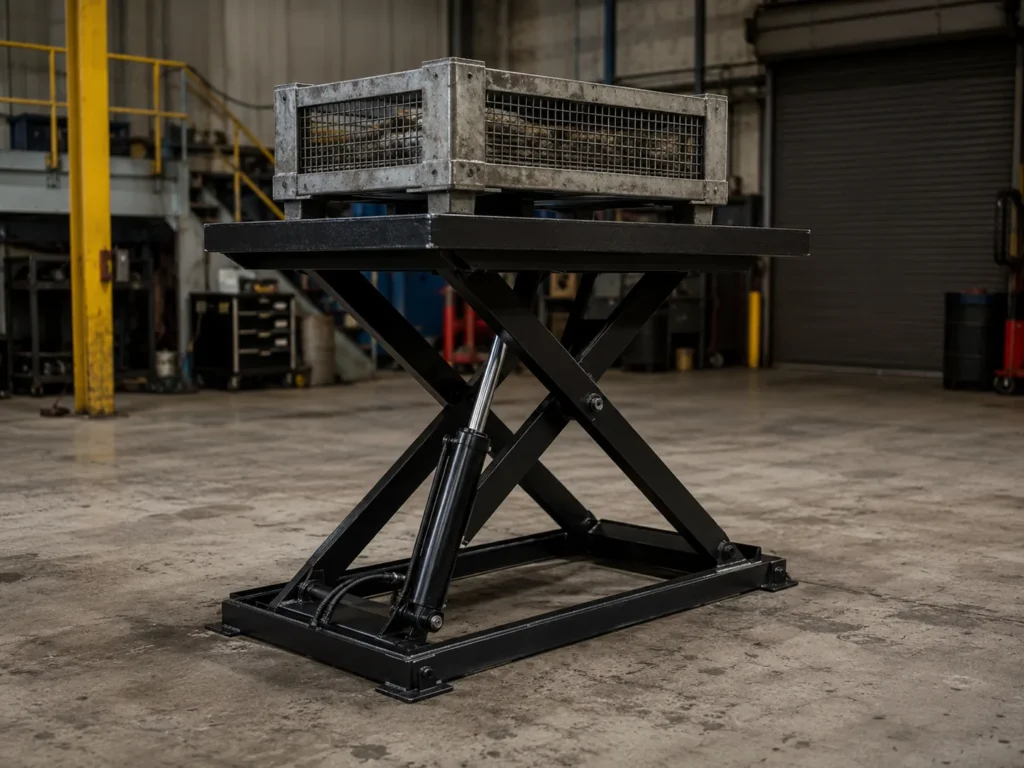
Single acting cylinders are used where one powered stroke performs the main work and the return stroke can be handled by load weight, spring force, or mechanical reset. The best applications are lifting, tipping, clamping, pressing, jacking, and controlled release, not bidirectional positioning.
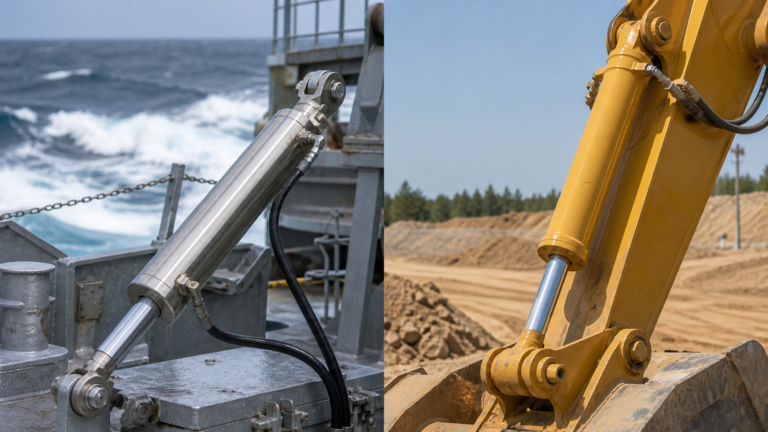
Typical single acting cylinder uses include hydraulic jacks, dump trailers, scissor lift tables, refuse compactors, agricultural tipping systems, vehicle lifts, material handling platforms, shop presses, and some industrial clamping fixtures. In these applications, the powered direction usually does the productive work: raising, pushing, pressing, or holding.
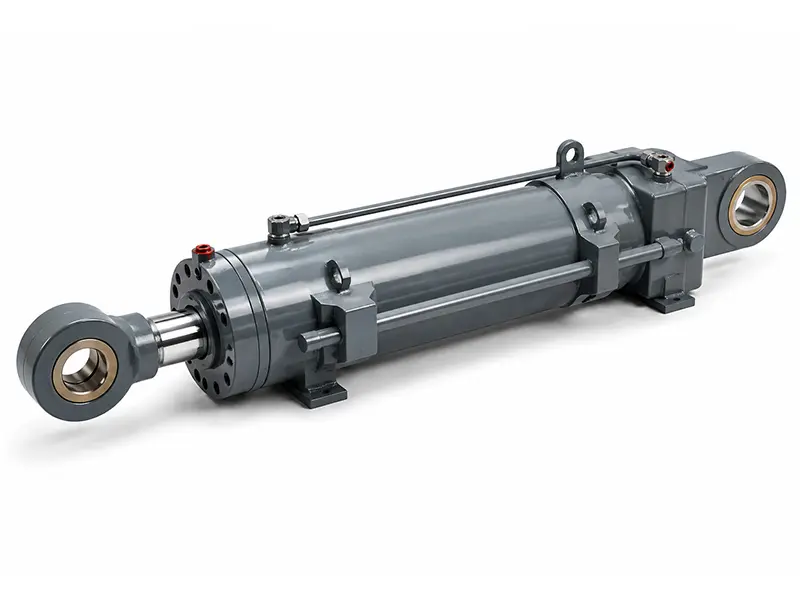
Procurement managers should still separate light equipment from heavy project equipment. A small shop jack may use a compact cylinder with basic mounting needs, while a dump trailer cylinder requires attention to rod stability, telescopic stage overlap, side-load tolerance, corrosion protection, hose routing, and end-pin wear. ZHY typically asks for equipment orientation, payload behavior, stroke, retracted length, mounting style, duty cycle, and environment before recommending a cylinder layout.
Mobile machinery is a strong fit because fewer hoses can simplify routing on moving frames. Industrial fixtures are also suitable when the return motion is not speed-critical. Horizontal equipment is less forgiving: without gravity, the cylinder needs a spring, linkage, counterweight, or powered retract. If none is present, a double acting cylinder is usually the safer and more controllable option.
What parameters matter before selecting a one way hydraulic cylinder?
The critical parameters are bore, stroke, pressure rating, rod diameter, mounting style, return method, seal material, operating temperature, side-load exposure, and duty cycle. Bore and pressure decide available force, while stroke, rod size, and mounting geometry determine stability and service life.
Force is calculated from pressure multiplied by effective piston area. For example, a 50 mm bore has about 1,963 mm² piston area; at 16 MPa, theoretical extension force is about 31.4 kN before friction and system losses. ISO 3320:2013 provides metric cylinder bore and rod diameter series, while ISO 3322 covers nominal pressure concepts used in fluid power components.
Pressure series also matter. ISO 6020-1 covers 16 MPa single rod cylinder mounting dimensions, and ISO 6022 covers 25 MPa series mounting dimensions for heavier applications. These standards do not replace supplier engineering, but they help buyers compare dimensional envelopes, mounting interfaces, and pressure class language across quotations.
| Situation | Recommended cylinder | Reason | Main procurement check |
|---|---|---|---|
| Vertical lift with reliable load weight | Single acting, gravity return | The load can push oil back to tank after pressure release. | Confirm minimum return load, guide friction, and lowering control valve. |
| Short clamp with automatic reset | Single acting, spring return | The spring can retract the rod without extra hydraulic plumbing. | Check spring force at full stroke and at end of life. |
| Horizontal push and pull | Double acting | Gravity cannot reliably return the rod in a horizontal axis. | Specify two-port control, retract force, and return speed. |
| Controlled retract near operators | Double acting or engineered safety circuit | Powered and metered return reduces unstable movement risk. | Review ISO 4413:2010 safety requirements and risk assessment. |
| Low-cost lift with simple cycle | Single acting if return is verified | Fewer hoses and simpler valves can reduce system complexity. | Validate return under cold oil, no-load, and worn-guide conditions. |
How to use this table: start with the “Situation” column, then treat the “Main procurement check” column as the deciding factor when two options seem close; if return force or operator safety is uncertain, prioritize the double acting recommendation.
What selection risks cause unstable movement or safety problems?
The main risks are undersized return force, wrong mounting alignment, excessive side load, poor lowering control, incompatible seals, inadequate rod stability, and assuming that a one-port cylinder can perform a two-direction control job. These errors often appear only after installation, when correction is expensive.
Risk 1: choosing single acting for controlled return
If return stroke speed and position must be controlled, a single acting cylinder is often the wrong architecture. Releasing oil to tank does not guarantee smooth motion when friction, load angle, temperature, and flow restriction change. A controlled machine needs metered hydraulic return or a mechanical control method designed into the system.
This mistake is common in retrofits where buyers want to reduce hose count. The short-term savings can create longer cycle times, unstable lowering, and operator complaints. ISO 4413:2010 emphasizes preventing unintended movement and controlling hydraulic hazards, so the safety review should happen before the purchase order, not after field failure.
Risk 2: ignoring side load and mounting geometry
Hydraulic cylinders are designed to push or pull along their axis. Side load can scrape seals, bend rods, wear bearings, and damage the barrel. Pin-mounted lift frames and dump bodies need enough freedom to align during motion, while rigid mounts require precise guide systems.
For long strokes, rod buckling becomes a serious concern. A cylinder may have enough hydraulic force but still be unsuitable because the rod is too slender for the unsupported length. Engineering review should include stroke, rod diameter, mounting style, load angle, and the worst-case extension point.
Risk 3: selecting seals without considering fluid and temperature
Seal material affects leakage, friction, low-temperature response, and chemical compatibility. Common hydraulic sealing families include nitrile rubber, polyurethane, fluorocarbon, and PTFE-based compounds, each with different strengths. Buyers should state hydraulic fluid type, operating temperature range, contamination exposure, and duty cycle rather than requesting a generic cylinder.
ZHY uses this information to avoid mismatches such as low-temperature sluggish return, excessive stick-slip, or premature rod seal wear. A cylinder that works during a warm factory test may behave differently in outdoor winter service or dusty agricultural use.
How do standards and industry trends affect cylinder selection?
Standards affect selection by giving buyers shared language for safety, dimensions, pressure classes, and component vocabulary. Industry trends add pressure for safer motion control, easier maintenance, cleaner hydraulic circuits, and more consistent replacement parts across mobile and industrial equipment fleets.
ISO 4413:2010 is the most relevant safety reference because it addresses general rules and safety requirements for hydraulic systems and components. Buyers should use it to frame risk assessment around pressure release, unintended movement, hose failure, stored energy, and safe maintenance. ISO 6020-1 and ISO 6022 are useful when standardized mounting dimensions matter for interchangeability and sourcing comparison.
The practical trend is not that single acting cylinders are disappearing. Instead, buyers are becoming more selective. Simple lift and dump functions still favor single acting designs, while automated machinery, operator-adjacent equipment, and precision return cycles increasingly justify double acting cylinders, load-holding valves, counterbalance valves, or sensors.
Another trend is documentation-driven procurement. Engineering buyers now ask for drawings, pressure ratings, seal specifications, port standards, test procedures, coating options, and packaging details earlier in the sourcing process. For MOFU buyers comparing suppliers, this is where ZHY can support a more technical RFQ rather than a price-only inquiry.
Real-world case examples: where the decision changes
Real equipment shows why the same cylinder category can be correct in one project and risky in another. The return-force source, machine orientation, operator exposure, and cycle repeatability are more important than the label “single acting.”
Warehouse lift table retrofit
A maintenance team replacing a worn lift table cylinder may correctly choose a gravity-return single acting cylinder if the table always lowers under platform weight and the lowering valve meters descent smoothly. The RFQ should include platform mass, rated load, stroke, closed length, pin diameter, port type, and lowering speed expectation.
Agricultural dump trailer
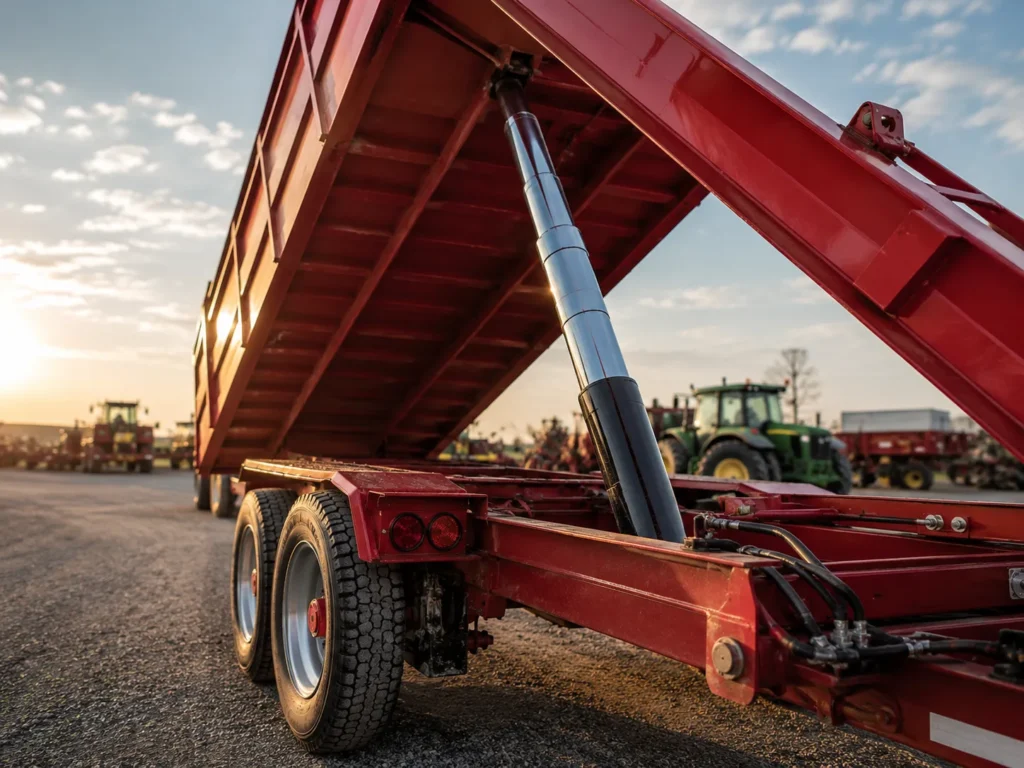
A dump trailer is usually a strong single acting case because the raised bed returns under gravity. The procurement risk appears when the bed is empty, the hinge is corroded, the telescopic stages are contaminated, or the trailer sits on uneven ground. A supplier should review minimum bed weight and stage overlap, not only maximum lifting force.
Horizontal production fixture
A horizontal clamp that must retract before an operator loads the next part is a weak single acting case unless a reliable spring-return mechanism is engineered. If cycle time matters, double acting control is the better choice because retract speed and force can be designed instead of assumed.
Practical Asset: RFQ checklist for single acting hydraulic cylinders
Use this checklist before requesting a quotation. It helps prevent the common mistake of buying a cylinder that can extend with enough force but cannot return safely in the real machine.
- State the powered direction first: ask whether the cylinder must push, lift, press, clamp, or hold, then confirm whether the return stroke is spring return, gravity return, or externally forced.
- Provide bore, stroke, retracted length, rod diameter, and required force; if bore is unknown, provide system pressure and load so the supplier can calculate piston area.
- Describe orientation: vertical lift, inclined dump, horizontal slide, pivoting linkage, or guided press. Ask the supplier to comment on side load and rod buckling risk.
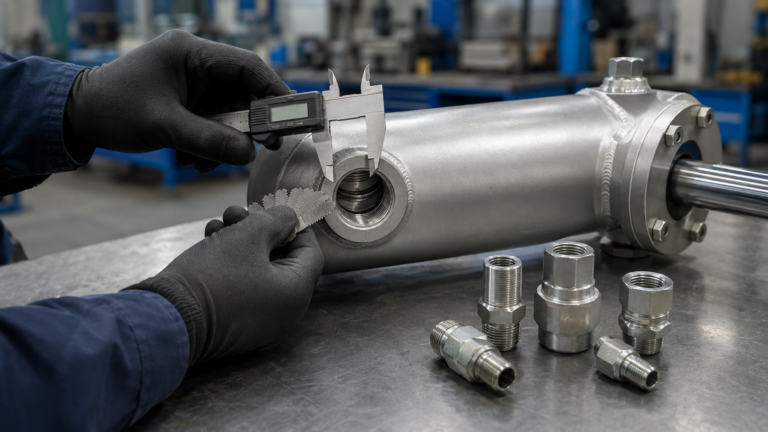
- Send mounting details: pin-to-pin length, clevis width, bearing type, flange pattern, trunnion position, port direction, and available installation space.
- Request pressure rating and test method. Ask whether the quoted design aligns with a recognized pressure class such as ISO 6020-1 or ISO 6022 where applicable.
- Specify return expectations: minimum return load, return time, empty-load condition, cold-start condition, and whether operators stand near the moving mechanism.
- Ask for seal material, operating temperature range, hydraulic fluid compatibility, rod coating, corrosion protection, and wiper arrangement for dusty or outdoor use.
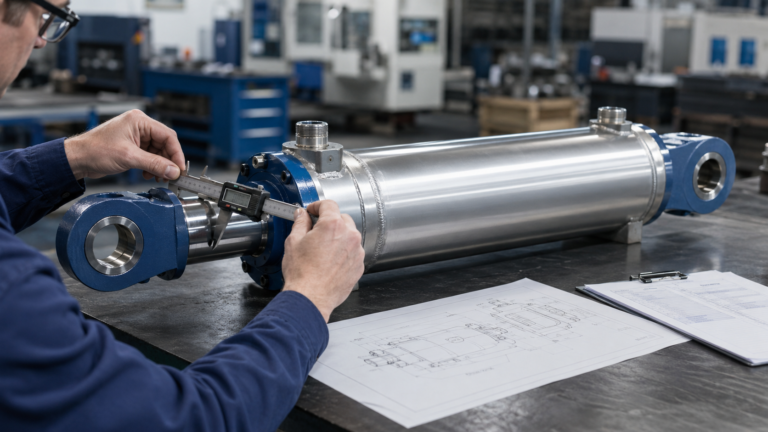
- Request a drawing before mass production. Check port thread, stroke tolerance, mounting center distance, rod end thread, and grease fitting access.
- Confirm packaging and identification: part number marking, protective caps on ports, rod protection, moisture control, and spare seal kit availability.
- For ZHY quotation review, attach photos of the existing cylinder and machine, then mark the working angle, load direction, and any previous failure mode.
FAQ
1. What is the basic working principle of a single acting hydraulic cylinder?
A single acting hydraulic cylinder uses pressurized oil on one side of the piston to create movement in one powered direction. The return stroke happens when pressure is released and a spring, gravity, or external force pushes the oil back through the same port. This makes the design simpler than a double acting cylinder, but it also means return motion is not hydraulically powered unless extra mechanisms are added.
2. Is a one way hydraulic cylinder the same as a single acting cylinder?
In most buyer and maintenance language, a one way hydraulic cylinder refers to a single acting cylinder because oil pressure drives only one direction of motion. The term is informal, so engineering drawings should still specify bore, stroke, pressure rating, port type, mounting, and return method. Using the formal term “single acting hydraulic cylinder” helps avoid confusion when comparing supplier quotations or replacement parts.
3. When should I choose a double acting cylinder instead?
Choose a double acting cylinder when the machine needs powered extension and powered retraction, controlled return speed, horizontal push-pull motion, or active holding in both directions. A single acting design is not the right shortcut if return motion affects operator safety or production cycle timing. The clearest decision rule is simple: if gravity or a spring cannot guarantee return under worst-case conditions, use double acting control.
4. What are the most common single acting cylinder uses?
Common uses include hydraulic jacks, dump trailers, scissor lift tables, compact presses, clamping fixtures, agricultural tipping systems, and vehicle lifting equipment. These applications work because the productive stroke is usually lifting, pressing, or pushing, while the return stroke is handled by gravity, spring force, or a mechanical reset. The application still needs validation for load variation, side load, temperature, contamination, and lowering control.
5. Which standards should buyers consider when specifying hydraulic cylinders?
ISO 4413:2010 is a key safety reference for hydraulic systems because it addresses general rules and safety requirements for systems and components. ISO 5598:2020 helps standardize fluid power vocabulary, while ISO 3320:2013, ISO 6020-1, and ISO 6022 are useful for metric cylinder sizes, mounting dimensions, and pressure series. Buyers should not treat standards as a complete design; they should use them to improve specification clarity and supplier comparison.
References
- ISO 4413:2010 Hydraulic fluid power — General rules and safety requirements for systems and their components, International Organization for Standardization, ISO, 2010.
- ISO 5598:2020 Fluid power systems and components — Vocabulary, International Organization for Standardization, ISO, 2020.
- ISO 3320:2013 Fluid power systems and components — Cylinder bores and piston rod diameters and area ratios — Metric series, International Organization for Standardization, ISO, 2013.
- ISO 3322:1985 Fluid power systems and components — Cylinders — Nominal pressures, International Organization for Standardization, ISO, 1985.
- ISO 6020-1:2007 Hydraulic fluid power — Mounting dimensions for single rod cylinders, 16 MPa series — Part 1: Medium series, International Organization for Standardization, ISO, 2007.
- ISO 6022:2018 Hydraulic fluid power — Mounting dimensions for single rod cylinders, 25 MPa series, International Organization for Standardization, ISO, 2018.
- Hydraulic Cylinder Division Catalog HY08-0910 Series 2H/3H Heavy Duty Hydraulic Cylinders, Parker Hannifin Corporation, Parker Hannifin, 2023.
- Industrial Hydraulics Manual, Bosch Rexroth AG, Bosch Rexroth, 2020.
How should buyers think about single acting cylinder value, risk, and sourcing?
The best way to evaluate a single acting cylinder is to separate mechanical suitability from purchase price. A single acting design can be the most efficient choice when the machine only needs one powered stroke, the return force is naturally available, and the safety circuit controls lowering or pressure release. It can also be the wrong choice when a buyer is trying to remove a hose, valve, or port from a function that actually needs bidirectional hydraulic authority.
From a sourcing perspective, the strongest buying reason is system simplicity. One pressure port, simpler hose routing, and a smaller valve requirement can reduce installation work in lifting platforms, dump bodies, compact presses, and maintenance tools. The practical value increases when the machine has a predictable gravity return or a short spring-return stroke. This is why many mobile and workshop applications still use single acting layouts even as hydraulic systems become more sensor-driven and safety-documented.
The main compliance consideration is not that a single acting cylinder violates safety expectations. The issue is whether the whole hydraulic system prevents unintended movement, manages stored energy, and allows safe maintenance, which is why ISO 4413:2010 remains important in procurement review. Dimensional standards such as ISO 6020-1 and ISO 6022 help buyers compare mounting envelopes and pressure classes, while ISO 5598 improves terminology consistency across drawings, purchase orders, and supplier discussions.
For an engineering buyer, the option logic is firm: specify single acting for verified lift, press, clamp, and dump functions with dependable return force; specify double acting for controlled retract, horizontal movement, or safety-critical bidirectional positioning. The most useful RFQ is not a request for the cheapest cylinder. It is a technical package that shows load direction, stroke, pressure, mounting, environment, return expectation, and failure concerns, allowing the supplier to confirm whether the design is genuinely suitable before production.