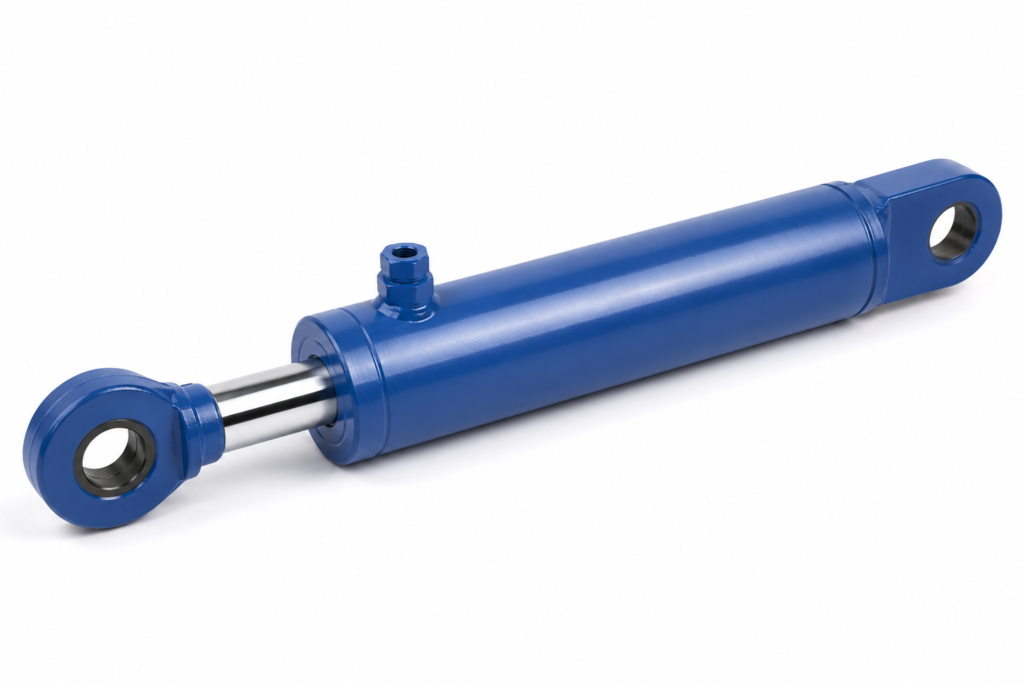
Hydraulic Cylinder Port Thread Guide: NPT, BSPP, BSPT, SAE ORB & Metric
Two hydraulic ports can look almost identical on your desk. One fitting starts smoothly, turns twice, and then stops. You add more force. It finally tightens, so the connection must be correct—right?
Unfortunately, that is how damaged threads, leaking ports, and delayed equipment assembly often begin. A fitting can partially engage even when its pitch, thread angle, taper, or sealing method is wrong.
This guide explains how to identify and select a hydraulic cylinder port thread. You will compare NPT, BSPP, BSPT, SAE ORB, ISO 6149, and common metric connections. You will also learn what to confirm before approving a custom or replacement cylinder.
Quick Summary
NPT, BSPP, BSPT, SAE ORB, and ISO 6149 ports differ in thread form, sealing method, and regional availability. NPT and BSPT are tapered. BSPP, SAE ORB, and ISO 6149 use parallel threads with a separate sealing feature. For an OEM or replacement cylinder, match the existing fitting and confirm pressure, flow, hose orientation, destination market, and the applicable standard.
Key Takeaways
- NPT, BSPP, BSPT, SAE ORB, and metric ports are not automatically interchangeable.
- Nominal size or thread diameter alone cannot identify a hydraulic connection.
- NPT and BSPT are both tapered, but their thread angles and pitches differ.
- BSPP normally requires an O-ring, bonded washer, cone, or other sealing surface.
- SAE ORB and ISO 6149 provide reliable O-ring sealing but use different threads.
- Port size should match required flow and cylinder speed, not only cylinder bore.
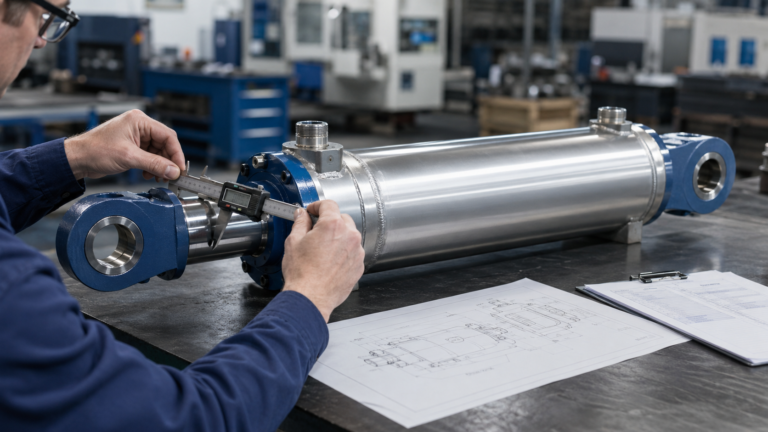
- OEM buyers should approve the port standard, size, position, angle, and sealing method on the production drawing.
What Is a Hydraulic Cylinder Port Thread?
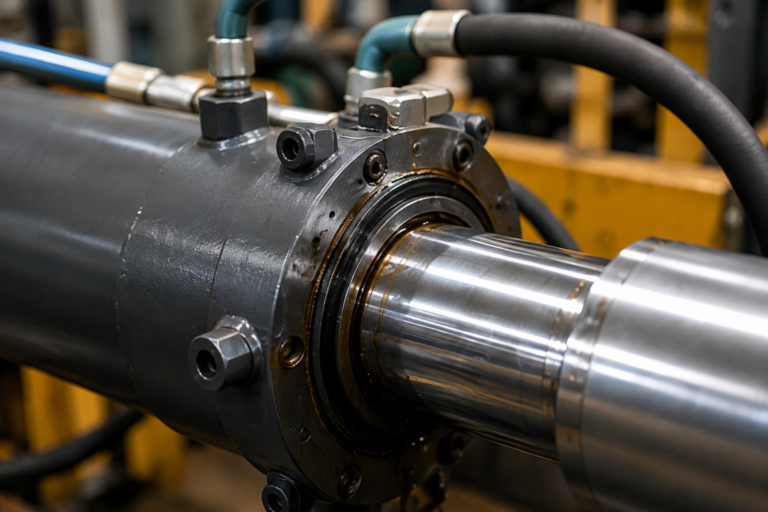
A hydraulic cylinder port thread is the threaded connection that joins the cylinder to a hose, tube, fitting, valve, or manifold. The port must retain the fitting, support the required pressure and flow, and create a reliable seal.
The thread does not always create the seal. Tapered pipe threads often seal through thread interference plus sealant. Straight threads normally rely on an O-ring, bonded washer, cone, or machined face.
This distinction matters when you specify a custom hydraulic cylinder. Writing only “1/2-inch port” or “M22 thread” leaves several critical details undefined.
What Are the Most Common Hydraulic Cylinder Port Threads?
| Port Type | Thread Form | Typical Seal | Common Markets | Important Check |
|---|---|---|---|---|
| NPT | Tapered, 60° | Thread interference and sealant | North America | Correct engagement and sealant |
| BSPP | Parallel, 55° | O-ring, bonded washer, or cone | Europe, UK, Asia | Exact sealing face |
| BSPT | Tapered, 55° | Thread interference and sealant | UK, Europe, Asia | Do not substitute NPT |
| SAE ORB | Straight UN/UNF, 60° | O-ring at port chamfer | North America | Chamfer and O-ring specification |
| ISO 6149 | Metric parallel, 60° | O-ring at port chamfer | Europe and global OEMs | Complete metric designation |
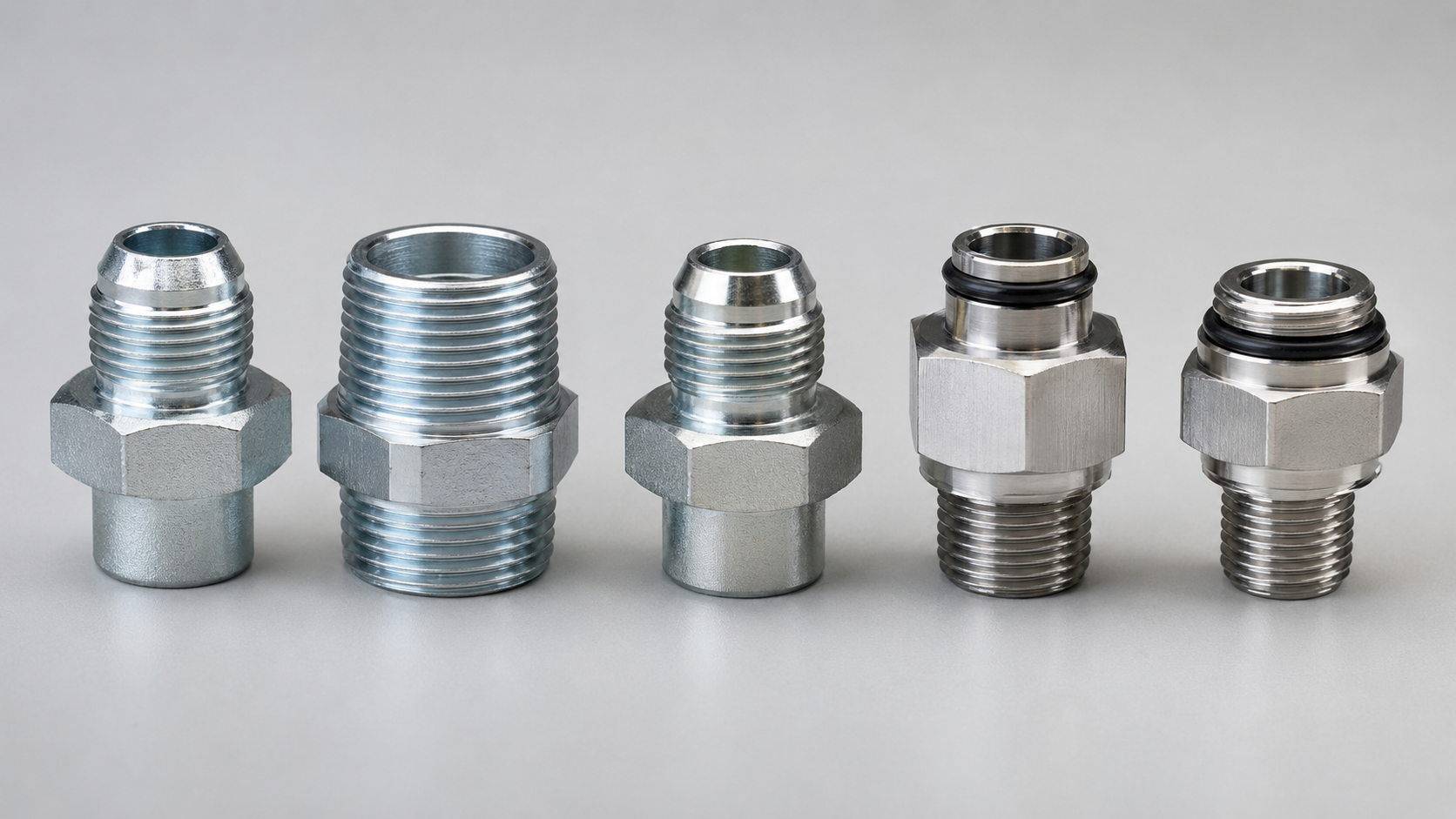
Hydraulic Port Performance Comparison
| Port Type | Leakage Control | Vibration Suitability | Serviceability | Recommended Starting Point |
|---|---|---|---|---|
| NPT | Moderate | Moderate | Requires careful resealing | Existing North American systems |
| BSPT | Moderate | Moderate | Requires careful resealing | Existing British or Asian systems |
| BSPP | Good | Good | Convenient with the correct seal | European and international machinery |
| SAE ORB | Very good | Very good | Easy when O-ring and seat are sound | North American mobile equipment |
| ISO 6149 | Very good | Very good | Easy when O-ring and seat are sound | Metric OEM systems |
Note: These ratings are practical comparisons, not universal pressure ratings. The actual result depends on the fitting series, material, port geometry, seal, assembly, fluid, temperature, and manufacturer specification.
What Is an NPT Hydraulic Cylinder Port?
NPT means National Pipe Taper. It uses a tapered 60-degree thread. The male and female threads create increasing interference as the fitting is tightened.
NPT is common on North American industrial, agricultural, and mobile equipment. A suitable hydraulic thread sealant is normally required because the thread form alone may leave a helical leakage path.
Advantages of NPT Ports
- Widely available in North America
- Simple and familiar to many maintenance teams
- Useful for existing machines already standardized on NPT
- Available in many fitting configurations
Limitations of NPT Ports
- Fitting orientation depends on final tightening position.
- Over-tightening can crack or deform the port boss.
- Repeated assembly can damage the female thread.
- Sealant can contaminate the hydraulic circuit when applied poorly.
- NPT must not be confused with BSPT.
When specifying NPT, state the full designation, pressure, fitting material, sealant procedure, and required orientation.
What Is a BSPP Hydraulic Cylinder Port?
BSPP means British Standard Pipe Parallel and is commonly identified by the letter “G.” It uses a parallel 55-degree thread. Because the diameter does not taper, the thread normally provides retention rather than the primary seal.
Sealing may use a bonded washer, O-ring and machined spotface, metal cone seat, or another fitting-specific surface. BSPP ports are common on European, British, Asian, marine, agricultural, and industrial equipment.
Advantages of BSPP Ports
- Widely used in international hydraulic systems
- Works with replaceable seals or bonded washers
- Allows practical fitting orientation with suitable fittings
- Available in a broad range of sizes
Limitations of BSPP Ports
- The sealing face must match the fitting design.
- A parallel thread alone does not guarantee a fluid-tight joint.
- It can be confused with metric or other straight threads.
- Poor spotface quality can damage the seal.
Do not write only “G 1/2.” Confirm the sealing arrangement and fitting style.
What Is a BSPT Hydraulic Cylinder Port?
BSPT means British Standard Pipe Taper. External tapered threads are often identified by an “R” designation. BSPT generally uses a 55-degree thread form and seals through tapered-thread interference with a compatible sealant.
BSPT appears on British, European, Japanese, and Asian equipment. The machine’s country of origin is only a clue; always verify the actual fitting and drawing.
Can You Connect BSPT to NPT?
No. Do not treat BSPT and NPT as interchangeable. They use different thread angles, several sizes have different pitches, and their crest and root profiles differ.
A mismatched fitting may start threading into the port and even pass an initial low-pressure check. It can still leak later under vibration, temperature change, or repeated pressure cycles.
What Is an SAE O-Ring Boss Port?
SAE O-ring Boss, or SAE ORB, uses a straight UN or UNF thread. An O-ring near the male fitting’s shoulder compresses against the female port chamfer. The thread retains the fitting; the O-ring creates the hydraulic seal.
SAE ORB is common on North American mobile, agricultural, construction, and truck equipment. It is often selected for double-acting hydraulic cylinders exposed to frequent pressure cycles.
Advantages of SAE ORB Ports
- Reliable O-ring sealing
- Strong external leakage control
- No thread sealant is normally required
- Good suitability for vibration and pressure cycling
- Adjustable fittings can simplify hose orientation
Limitations of SAE ORB Ports
- The chamfer and spotface must be machined correctly.
- A cut or unsuitable O-ring can cause immediate leakage.
- O-ring material must match the fluid and temperature.
- ORB threads can be confused with other UN or UNF connections.
SAE ORB is often practical for compact welded hydraulic cylinders. The designer must still check boss strength and fitting clearance.
What Is an ISO 6149 Metric Port?
ISO 6149 ports use metric straight threads and an elastomeric O-ring seal. The female port includes controlled geometry for the chamfer and spotface.
The sealing principle resembles SAE ORB, but the threads and port specifications differ. They must not be mixed. ISO 6149 is common on European machinery and internationally designed OEM systems.
The correct thread is only one part of the port. Chamfer diameter, spotface, perpendicularity, surface finish, and O-ring selection all affect sealing.
What Are Metric DIN Hydraulic Connections?
“Metric thread” is not a complete port specification. Metric hydraulic systems can seal with an O-ring, bonded washer, 24-degree cone, sealing edge, flat face, or fitting-specific metal seat.
DIN- and ISO-style metric connections are widely used in European industrial machines, hydraulic presses, and material-handling equipment. A tie-rod hydraulic cylinder may use a metric connection matching the factory’s tube system.
Confirm the complete designation, such as M22 × 1.5, together with the standard, male or female form, sealing method, spotface, seal specification, orientation, and pressure rating.
Which Standards Apply to Hydraulic Cylinder Ports?
The approved engineering drawing should identify the standard controlling the port geometry. Common references include:
- ISO 6149: Metric ports and stud ends using an elastomeric O-ring seal.
- ISO 1179: Ports and stud ends using ISO 228-1 pipe threads.
- SAE J1926: Straight-thread O-ring ports and stud ends.
- ASME B1.20.1: General-purpose inch pipe threads, including NPT.
- ISO 7-1: Pipe threads where pressure-tight joints are made on the threads.
- ISO 228-1: Pipe threads where pressure-tight joints are not made on the threads.
A standard number alone may not define the entire cylinder connection. Confirm the fitting series, sealing method, size, pressure rating, spotface, position, orientation, and inspection requirements. Also confirm the current edition required by your contract or destination market.
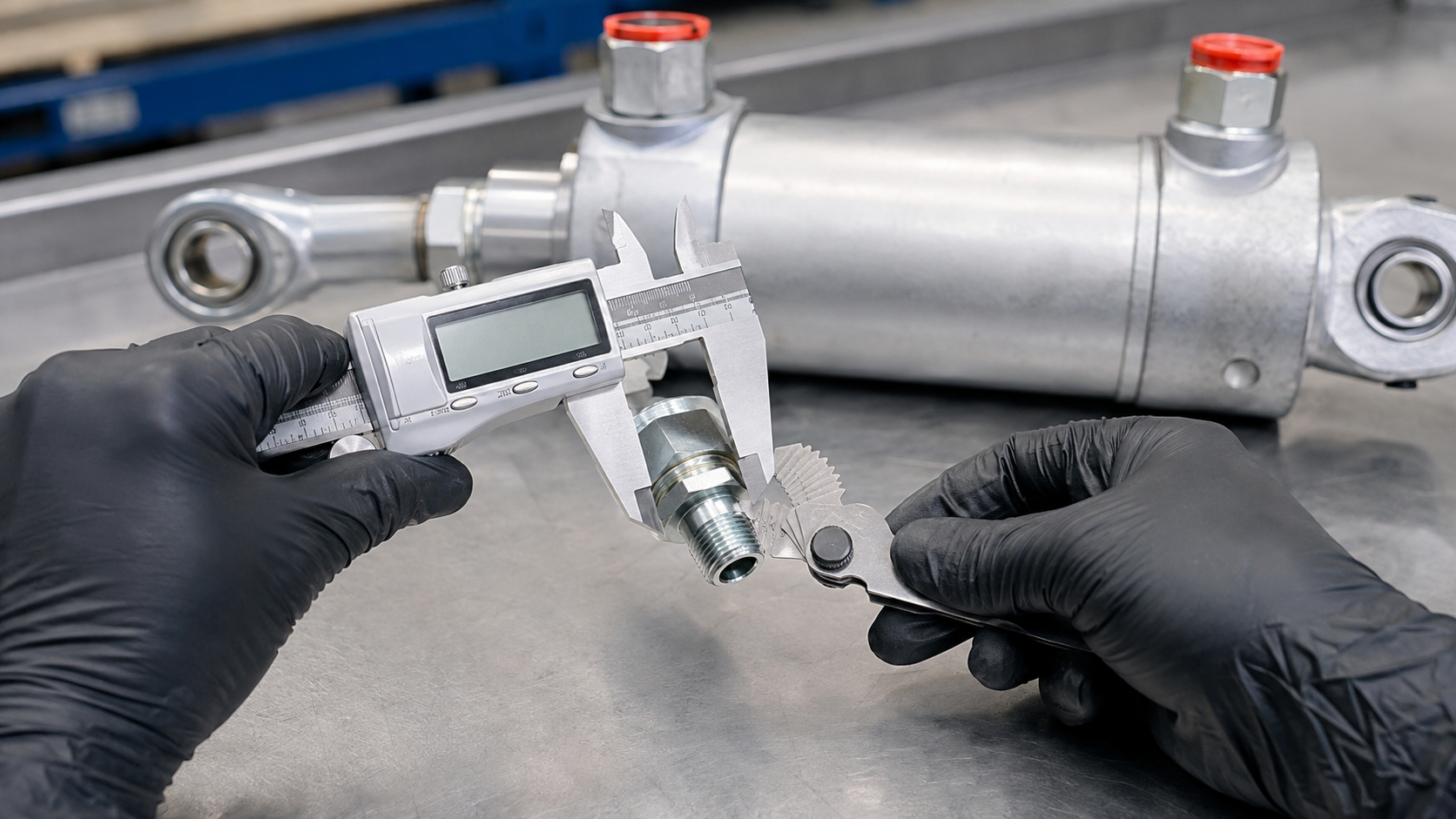
How Do You Identify an Existing Hydraulic Port Thread?
1. Clean the Port and Fitting
Remove oil, dirt, paint, corrosion, PTFE tape, sealant, and burrs. Cleaning reveals the O-ring, cone, washer seat, shoulder, or tapered thread that actually forms the seal.
2. Determine Whether the Thread Is Tapered or Parallel
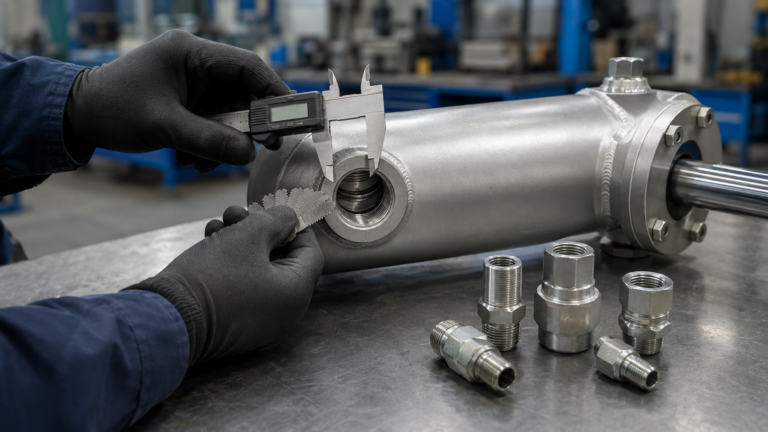
Measure the diameter near the first complete thread and farther from the end. A parallel thread remains almost constant; a tapered thread changes diameter along its length.
3. Measure the Thread Diameter
Measure a male fitting across the thread crests. Female ports are harder to measure accurately, so use the original male fitting or a verified plug gauge where possible. Nominal pipe size is not the actual outside diameter.
4. Measure the Thread Pitch
Use a pitch gauge to identify threads per inch or the metric distance between crests. Similar diameters can have different pitches.
5. Inspect the Sealing Method
Look for thread interference, a base O-ring, face O-ring, bonded washer, internal cone, external cone, chamfer, or flat spotface. The seal location is one of the strongest identification clues.
6. Compare with a Reliable Technical Chart
Compare diameter, pitch, angle, taper, designation, and sealing geometry with the fitting manufacturer’s data or applicable standard.
7. Confirm with a Gauge or Original Fitting
Never force a test fitting. If you are buying a replacement hydraulic cylinder, send the original fitting or adapter with the old cylinder when practical.
Common Hydraulic Thread Identification Mistakes
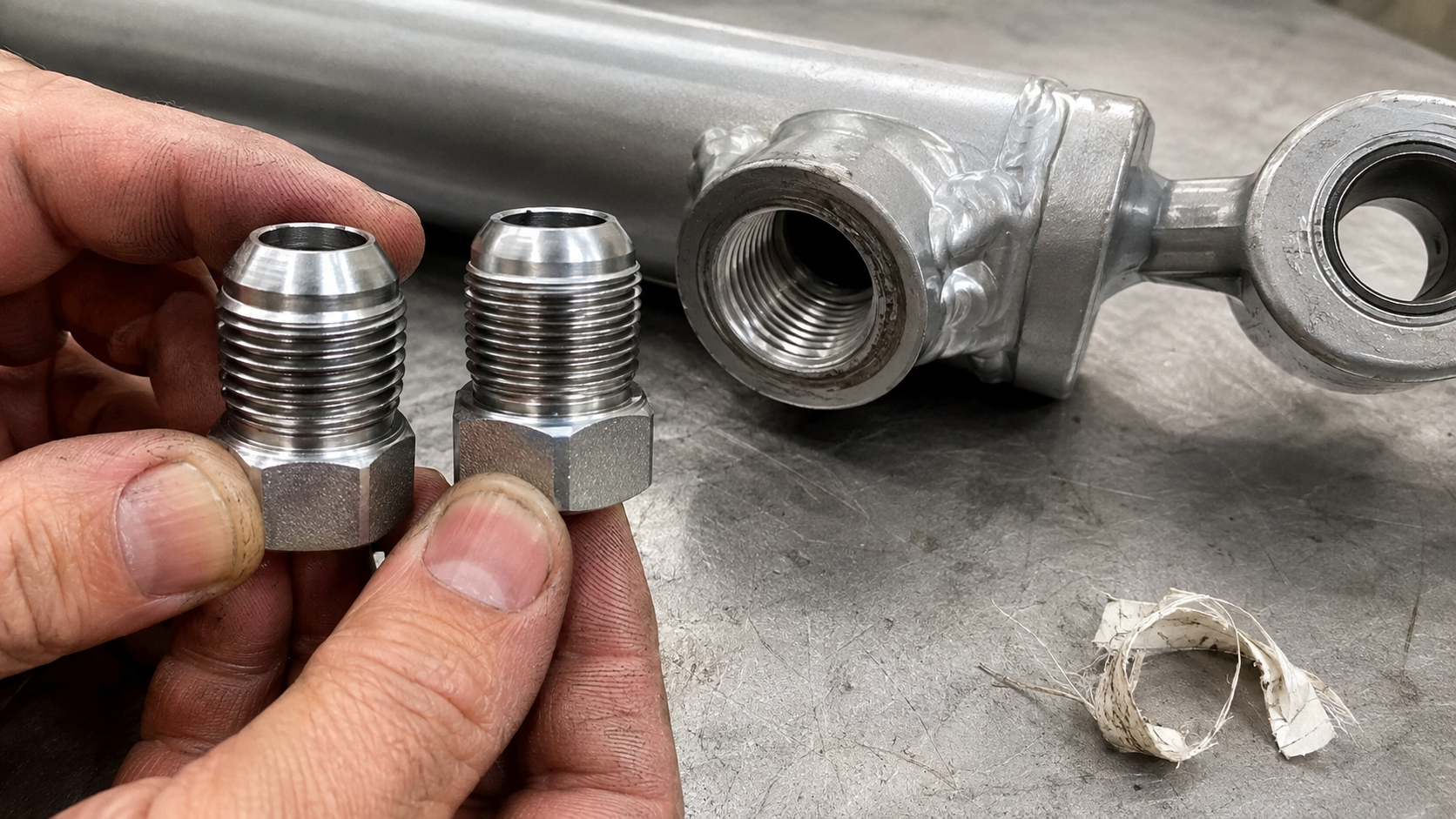
Mistake 1: Ordering by Nominal Size
“1/2-inch thread” does not tell the supplier whether you need NPT, BSPP, BSPT, ORB, or another connection.
Mistake 2: Assuming It Is Correct Because It Screws In
Different threads can partially engage. Continued tightening may permanently damage both components.
Mistake 3: Ignoring the Sealing Surface
Sealant cannot correct a missing O-ring, wrong cone, damaged washer, or poorly machined spotface.
Mistake 4: Copying the Thread but Not Its Position
The correct fitting can still be unusable if the hose contacts the bracket, frame, rod-end structure, guard, or another line during movement.
Mistake 5: Adding an Adapter Without Checking Clearance
An adapter adds length, bending load, and another possible leakage point. Check its pressure rating and movement envelope.
Mistake 6: Reusing a Damaged Fitting
A new cylinder may leak because the old fitting has damaged threads, a cut O-ring, scratched face, corrosion, or previous over-tightening damage.
Not Sure Which Port Thread You Have?
Send clear photographs of the port and original fitting, plus diameter and thread-pitch measurements. Our engineering team can review the connection before quotation.
How Do You Select the Correct Hydraulic Port Size?
Thread type and port size are separate decisions. The flow path must deliver the required oil volume without unacceptable velocity, turbulence, heat, or pressure loss.
Check cylinder bore, rod diameter, extension and retraction speed, pump flow, duty cycle, hose length, valve capacity, fluid viscosity, temperature, and allowable pressure loss.
A slow-moving press cylinder can use moderate flow despite its large bore. A smaller, fast-moving cylinder may need a larger port than its dimensions suggest. Restrictions are especially important in heavy-duty hydraulic cylinders exposed to high loads and repeated cycles.
Does Port Size Affect Hydraulic Cylinder Speed?
Theoretical speed mainly depends on oil flow and effective piston area. However, an undersized port, fitting, hose, or valve restricts flow, increases pressure loss, and can make actual speed lower than expected.
Extension and retraction behavior can differ because piston and annular areas are unequal. Check the whole flow path, not only the pump rating.
Hydraulic Port Selection by Purchasing Scenario
| Purchasing Scenario | Recommended Starting Point | Main Reason |
|---|---|---|
| North American mobile equipment | SAE ORB | Good leakage control and fitting availability |
| Existing North American machinery | Match NPT or SAE ORB | Maintains compatibility with current hoses |
| European OEM machinery | ISO 6149 or BSPP | Fits common metric and European systems |
| Asian export equipment | BSPP, BSPT, or metric | Final choice follows the destination market |
| High-vibration equipment | O-ring-sealed connection | Better external leakage control |
| One-time replacement cylinder | Match the original fitting | Reduces hose and adapter changes |
| New OEM production | Standardize one connection system | Simplifies assembly and spare parts |
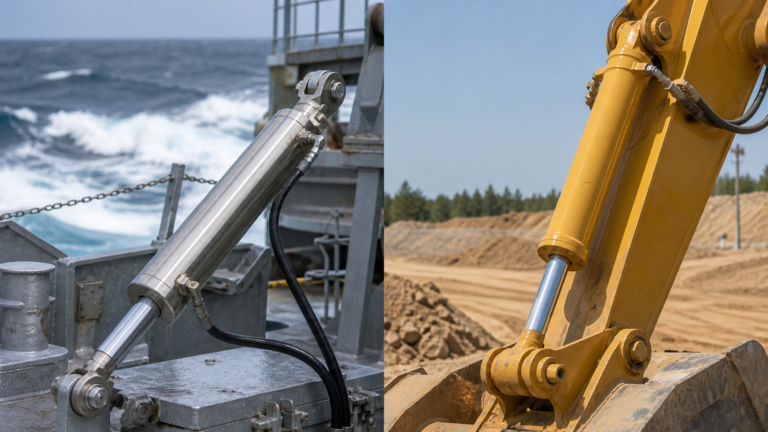
| Marine equipment | O-ring seal plus corrosion-resistant materials | Controls leakage and environmental damage |
Use this table as a starting point, not a substitute for engineering review. Working pressure, peak pressure, flow, fitting availability, environment, and approved drawings control the final choice.
Which Port Thread Fits Different Applications?
Construction and Mobile Equipment
SAE ORB, metric O-ring ports, BSPP, and approved flange connections are common. For construction hydraulic cylinders, check hose clearance throughout the full movement.
Agricultural Machinery
NPT, BSPP, BSPT, SAE ORB, and metric ports are all used. Match the tractor, implement, dealer service network, and destination market. For tractor hydraulic cylinders, confirm whether the hose connects directly or through an elbow, adapter, or valve block.
Dump Trucks and Telescopic Cylinders
High flow, compact installation, tipping-body movement, and chassis hose routing all matter. A telescopic hydraulic cylinder needs port positioning that prevents contact during lifting and lowering.
Forklifts and Material Handling
Compact space is often the main challenge. Check elbows, mast movement, carriage clearance, and hose twisting before approving the port orientation.
Industrial Machines and Hydraulic Presses
Metric, BSPP, SAE ORB, and standardized industrial connections may all be suitable. Standardizing connections across several machines reduces spare-part complexity and assembly mistakes.
Marine Equipment
Consider thread type together with fitting material, coating, salt spray, moisture, and seal compatibility. For marine hydraulic cylinders, evaluate the complete port and fitting assembly.
Should You Use a Hydraulic Adapter?
An adapter can be practical when an existing hose and new port use different standards, changing the cylinder is impractical, space is sufficient, and the adapter has the correct pressure and material rating.
For new OEM production, a direct connection is usually better. It reduces component count, assembly time, installed length, leakage points, and spare-part complexity.
For a prototype or one-time replacement, an adapter may be the fastest safe solution. For batch production, consider machining the cylinder port to match the hose system directly.
OEM Hydraulic Cylinder Port Checklist
Connection Standard
- Complete thread designation and applicable standard
- Tapered or parallel thread
- Male or female fitting
- Original hose-fitting model
- Local fitting availability
Sealing
- Thread, O-ring, washer, cone, or face sealing method
- Correct chamfer and spotface
- Seal material compatible with fluid and temperature
- Approved sealant when required
Flow and Pressure
- Normal, peak, and test pressure
- Pump flow and required cylinder speed
- Port, fitting, hose, valve, and adapter ratings
- Acceptable pressure loss and oil velocity
Installation
- Port position and angular orientation
- Wrench and fitting clearance
- Hose movement through the full cylinder stroke
- Protection against rubbing, impact, and bending loads
Procurement and Inspection
- Approved drawing revision
- Original fitting or verified gauge used for confirmation
- Port protected against paint and transport damage
- Pressure and external-leakage test completed
- Approved fitting and seal details recorded for repeat orders
Recommended Prototype Evaluation Protocol
- Verify the drawing. Compare thread, size, location, and angle with the approved revision.
- Inspect the thread. Look for burrs, paint, distortion, corrosion, and damaged crests.
- Inspect the seal surface. Confirm that the chamfer, spotface, cone, or washer seat is clean.
- Install the specified fitting. Use the actual production fitting without force.
- Check orientation and wrench clearance. Ensure technicians can assemble it after installation.
- Check hose routing. Cycle the cylinder and inspect for rubbing, twisting, stretching, and impact.
- Perform pressure testing. Follow the approved pressure and inspection procedure.
- Inspect for leakage. Check the port, fitting, boss, and nearby weld after pressure cycling.
- Record the approved configuration. Save the fitting, seal, photos, and drawing revision.
How ZHY Hydraulic Helps Confirm the Correct Port
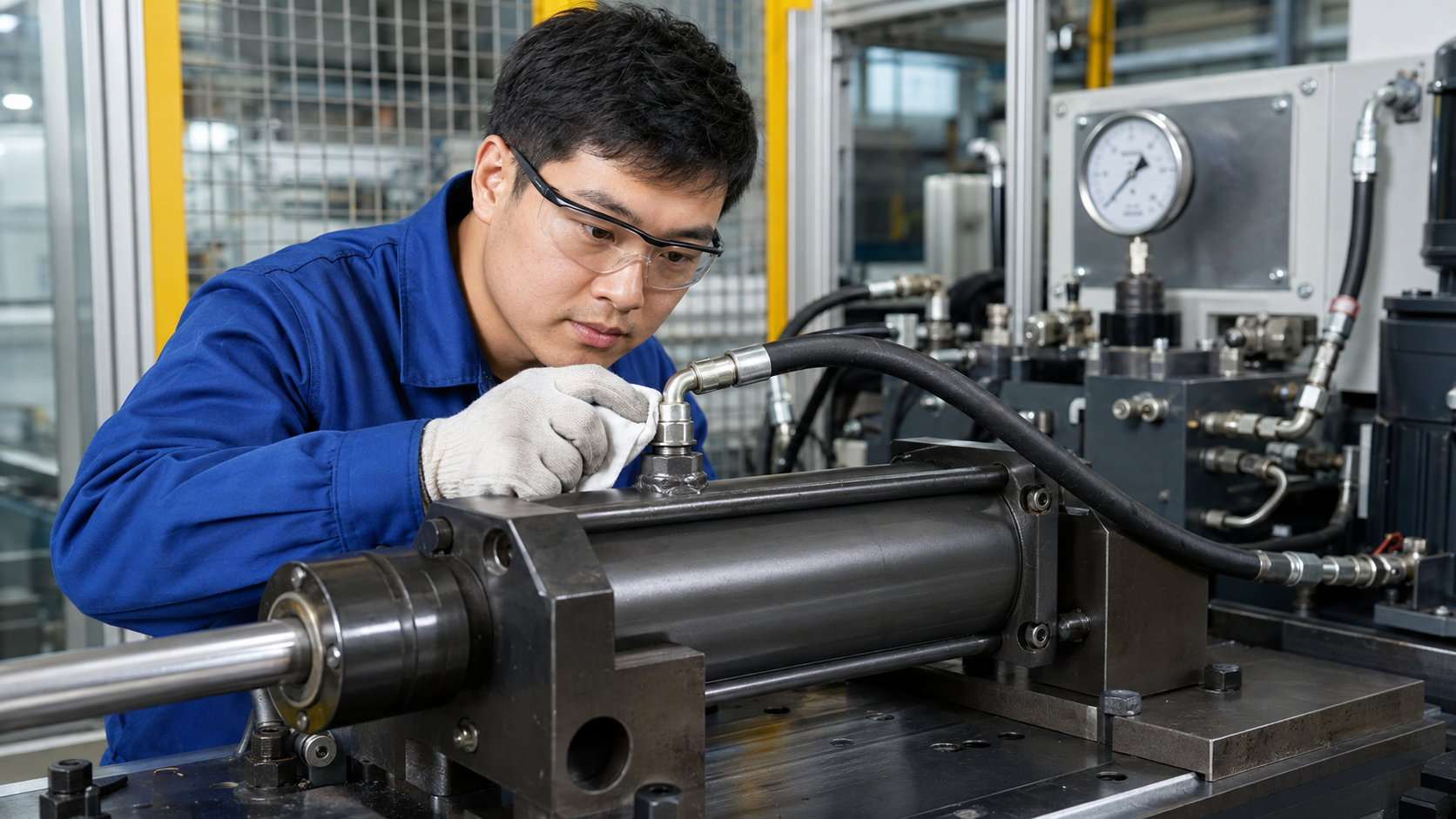
You do not need to identify an unknown port from memory. You can send ZHY Hydraulic a cylinder drawing, original fitting, old cylinder, clear photographs, diameter and pitch measurements, equipment model, hydraulic schematic, pressure, flow, and installation-space details.
Our engineering team reviews the connection together with bore, rod diameter, stroke, mounting dimensions, seals, materials, pressure, and operating environment. This prevents the port from being treated as an isolated specification.
ZHY Hydraulic manufactures custom hydraulic cylinders built to customer drawings, samples, fittings, and technical requirements. Port type, sealing geometry, position, orientation, and boss structure can be confirmed before production.
Confirm Your Port Before Production
Send your drawing, original fitting, old cylinder, or clear measurement photos. We can review the connection with the cylinder dimensions and operating conditions.
What Should You Send for an Accurate Quotation?
- Equipment type and cylinder function
- Bore, rod diameter, and stroke
- Closed and extended length
- Mounting and pin dimensions
- Working, peak, and test pressure
- Port thread, size, position, and orientation
- Required flow or operating speed
- Hydraulic fluid and temperature
- Working environment and surface treatment
- Required quantity and delivery date
If the thread is unknown, write “to be identified” instead of guessing. Include photographs of the fitting, seal surface, port entrance, and complete cylinder installation with a caliper or scale visible.
Frequently Asked Questions
What is the most common hydraulic cylinder port thread?
NPT, BSPP, BSPT, SAE ORB, and metric O-ring ports are all common. The right one depends on the existing system, market, pressure, flow, seal, and maintenance needs.
Are BSPP and NPT threads interchangeable?
No. BSPP is a parallel 55-degree thread, while NPT is a tapered 60-degree thread. Their pitch, shape, and sealing methods differ.
Are BSPT and NPT the same?
No. Both are tapered, but BSPT generally uses a 55-degree form and NPT uses 60 degrees. Several nominal sizes also have different pitches.
Does BSPP need thread sealant?
BSPP normally seals through an O-ring, bonded washer, cone, or another designed surface. The parallel thread is not normally the primary seal.
Does SAE ORB need PTFE tape?
No. SAE ORB seals with an O-ring at the port chamfer. PTFE tape must not replace the correct O-ring and port geometry.
How can you tell whether a thread is metric or BSPP?
Measure diameter and pitch, then inspect the thread angle and sealing arrangement. Use a thread gauge and a verified chart because some sizes look similar.
Can ZHY copy the port from an old cylinder?
Yes. Send the old cylinder, original fitting, photos, or detailed measurements. Confirm the final standard and seal geometry on the production drawing.
Can you change the port thread on a replacement cylinder?
Yes, if the new port matches the hose system and the boss has sufficient strength. Pressure, flow, clearance, and orientation must also be checked.
Is a larger hydraulic port always better?
No. Larger ports may reduce restriction but need more space and larger fittings. Select size from flow, speed, pressure loss, and installation limits.
Why does a new cylinder leak around the port?
Possible causes include mixed standards, a damaged O-ring, wrong fitting, poor spotface, unsuitable sealant, over-tightening, contamination, or hose loading.
Final Selection Recommendations
- For a replacement cylinder: match the original fitting and sealing geometry unless a system change has been engineered.
- For North American mobile equipment: start by evaluating SAE ORB; retain NPT when compatibility with an existing system requires it.
- For European metric OEM equipment: evaluate ISO 6149 or the specified BSPP connection.
- For high-vibration or frequent-cycle service: prioritize a correctly designed O-ring-sealed connection.
- For new OEM production: standardize the connection system and record every detail on the approved drawing.
- When identification is uncertain: send the original fitting, cylinder, photos, and measurements to the manufacturer. Do not force a test fitting.
The safest choice comes from the complete connection—not nominal size alone. Confirm thread form, pitch, taper, seal, pressure, flow, orientation, clearance, environment, and applicable standard before production.