What should OEM and replacement buyers decide first?
The first decision is not brand, price, or delivery time; it is whether the cylinder can safely produce the required force within the pressure your system can actually supply. For an OEM buyer, that means designing from load cases. For a replacement buyer, it means confirming the existing machine pressure, bore, stroke, mounting dimensions, and porting before asking for a quote.
A common procurement failure starts with an incomplete message such as “send price for a 100 mm hydraulic cylinder.” That description omits bore, rod diameter, stroke, mounting type, working pressure, seal material, port standard, rod end, operating temperature, surface protection, and quantity. The consequence is predictable: the quoted cylinder may have the wrong force, fail to fit the bracket, move too slowly, or leak prematurely in the real environment.
For BOFU commercial investigation, the practical route is sequential. Identify the load, confirm pressure, calculate bore, verify rod strength, choose stroke, match mounting, check speed and flow, then specify seals and corrosion protection. ZHY engineering reviews typically begin from this chain because it prevents quotation discussions from becoming disconnected from machine function.
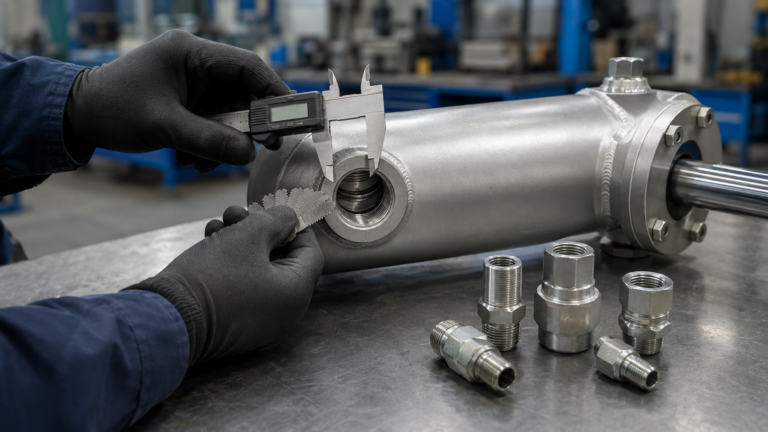
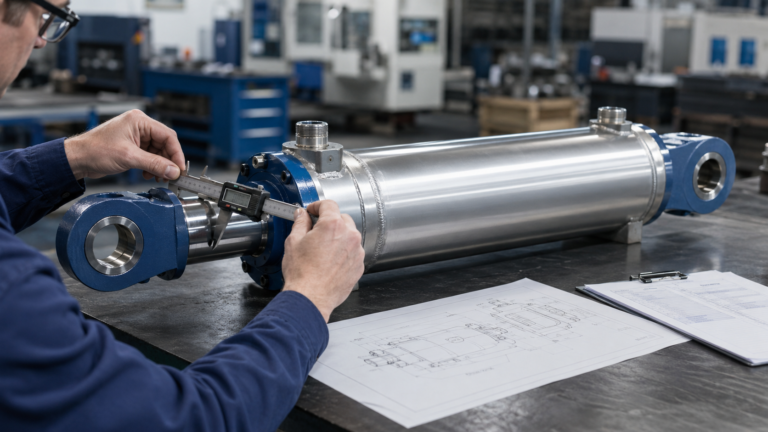
For replacement buyers, the safest starting point is documentation plus measurement. Record the nameplate if available, take center-to-center pin dimensions at retracted and extended positions, measure pin diameter, port thread, barrel outside diameter, rod diameter, and stroke, then photograph the installation angle and hose routing. A cylinder selected only by appearance can still be wrong if the clevis width, pin offset, or port orientation differs.
Key Takeaways
- Start from load and available system pressure; bore size is a result of force demand, not a guess.
- Replacement buyers should measure pin-to-pin length, stroke, rod diameter, bore evidence, mount width, and port thread before quotation.
- Mounting style controls side load risk, alignment tolerance, and whether the cylinder survives real movement.
- Seal choice should follow fluid type, temperature, duty cycle, contamination level, and outdoor exposure.
- ISO dimensional standards help interchangeability, but machine-specific brackets and ports still require confirmation.
How do you calculate bore size from load and pressure?
To size bore, divide required force by available pressure and add a realistic safety margin for friction, pressure loss, load variation, and operating angle. In plain terms, a cylinder must be sized for the worst working load at the lowest dependable pressure, not for the highest pump rating printed in a catalog.
The basic extension force formula is Force = Pressure × Piston Area. When using SI units, pressure in pascals multiplied by area in square meters gives force in newtons. For retraction force, subtract rod area from piston area because the rod occupies part of the effective surface. This is why a double-acting cylinder normally has less pulling force than pushing force at the same pressure.
As a quick example, a 100 mm bore has a piston area of about 7,854 mm². At 160 bar, theoretical extension force is about 125.7 kN before efficiency and losses. If the machine needs 110 kN continuously, that cylinder may appear adequate on paper, but buyers should still account for linkage angle, seal friction, load shock, and relief valve setting. A larger bore or higher validated pressure may be needed if the application involves impact, uneven ground, or frequent stall conditions.
The strongest rule for how to select a hydraulic cylinder size is this: if the load is uncertain, do not compensate by guessing a bigger stroke or heavier rod. Confirm the working load path first, because bore controls force while stroke controls travel. Oversizing bore also increases oil volume, slows cycle time at the same pump flow, raises material cost, and can overload machine structures if relief settings are changed carelessly.
| Situation | Primary specification to confirm | Recommended action | Risk if skipped |
|---|---|---|---|
| Known load, known pressure | Bore and rod diameter | Calculate extension and retraction force, then add a margin for losses and duty severity. | Undersized bore may stall or force operators to raise pressure beyond safe limits. |
| Known machine, missing cylinder drawing | Stroke, pin centers, mount width, port thread | Measure the removed cylinder and photograph the installed position before requesting a quotation. | The new cylinder may not fit brackets or may put hoses in conflict with the frame. |
| Fast cycle required | Flow rate, bore volume, port size | Check whether pump flow can fill the cylinder volume at the desired speed. | Oversized cylinders move slowly and may overheat the hydraulic system. |
| Outdoor or corrosive service | Rod coating, seal material, paint system | Specify exposure conditions, washdown, salt spray, and storage before shipment. | Rod pitting can damage seals and cause leakage long before mechanical fatigue occurs. |
| Long stroke under compression | Rod buckling and mounting alignment | Ask engineering to verify column strength, guide support, and side load control. | A long rod can bend even when bore force appears sufficient. |
How to use this table: read the first column as your purchase scenario, then prioritize the second column before price comparison; if two situations are both true, resolve the force and fit requirements first, then optimize speed and environmental protection.
Which cylinder terms must appear in a quotation request?
A quotation-ready specification should describe both performance and interface dimensions. The buyer does not need to write a full engineering manual, but the request must include enough information for a supplier to confirm force, movement, fit, sealing, and manufacturability without guessing.
The following terms are the minimum vocabulary for an OEM or replacement inquiry. They also help internal procurement teams compare quotes fairly. Two cylinders with the same bore and stroke may still differ significantly in rod strength, mounting, seal package, porting, surface treatment, testing, and documentation.
- Bore
- The internal piston diameter that mainly determines extension force at a given pressure.
- Rod diameter
- The chrome or coated rod diameter that affects retraction force, buckling resistance, and durability.
- Stroke
- The linear travel distance from fully retracted to fully extended position.
- Mounting style
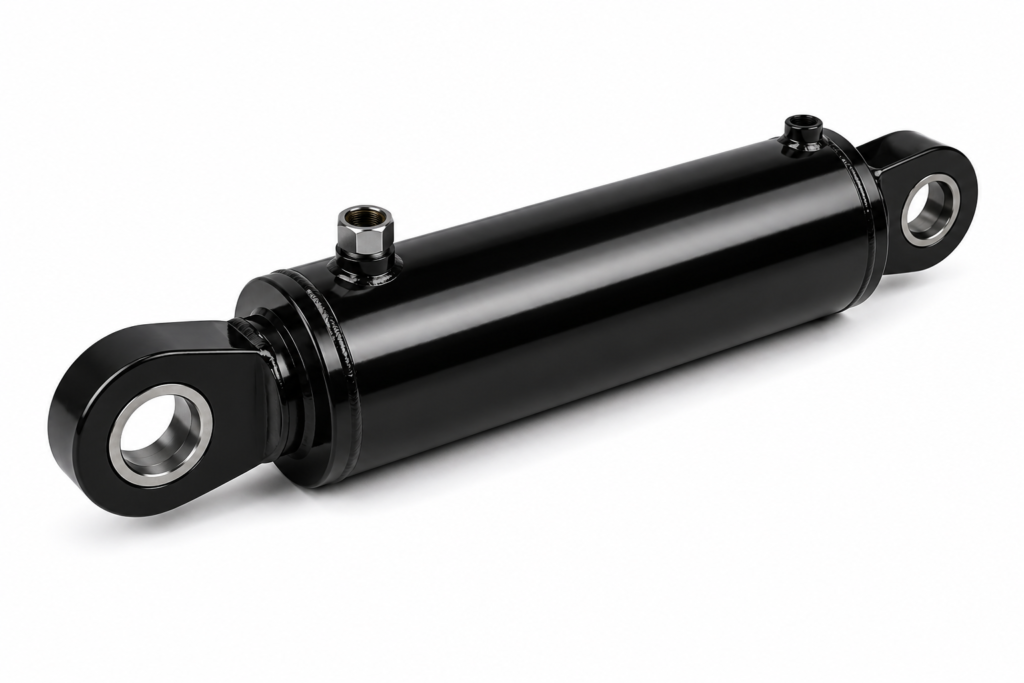
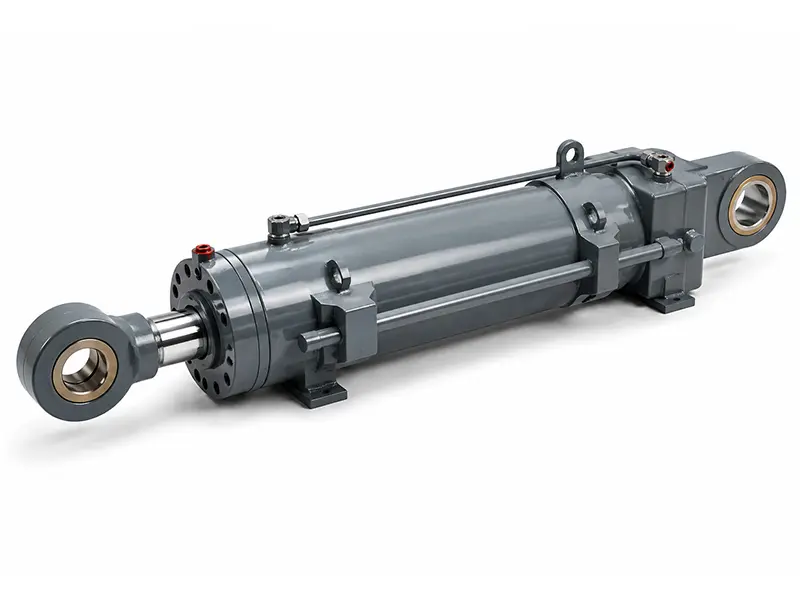
- The mechanical connection method, such as clevis, trunnion, flange, foot, spherical bearing, or threaded end.
- Working pressure
- The normal operating pressure the cylinder is expected to handle repeatedly, separate from proof or burst testing.
- Seal material
- The elastomer or polymer system selected for oil compatibility, temperature, speed, contamination, and leakage control.
For OEM programs, add drawing revision, annual volume, target cost range, duty cycle, test requirements, packaging method, and PPAP or inspection expectations if applicable. For replacement orders, add clear photos from multiple angles and mark the cylinder in the machine position. The most useful inquiry combines measurement, operating conditions, and commercial quantity in one file.
How should you choose mounting, stroke, and speed together?
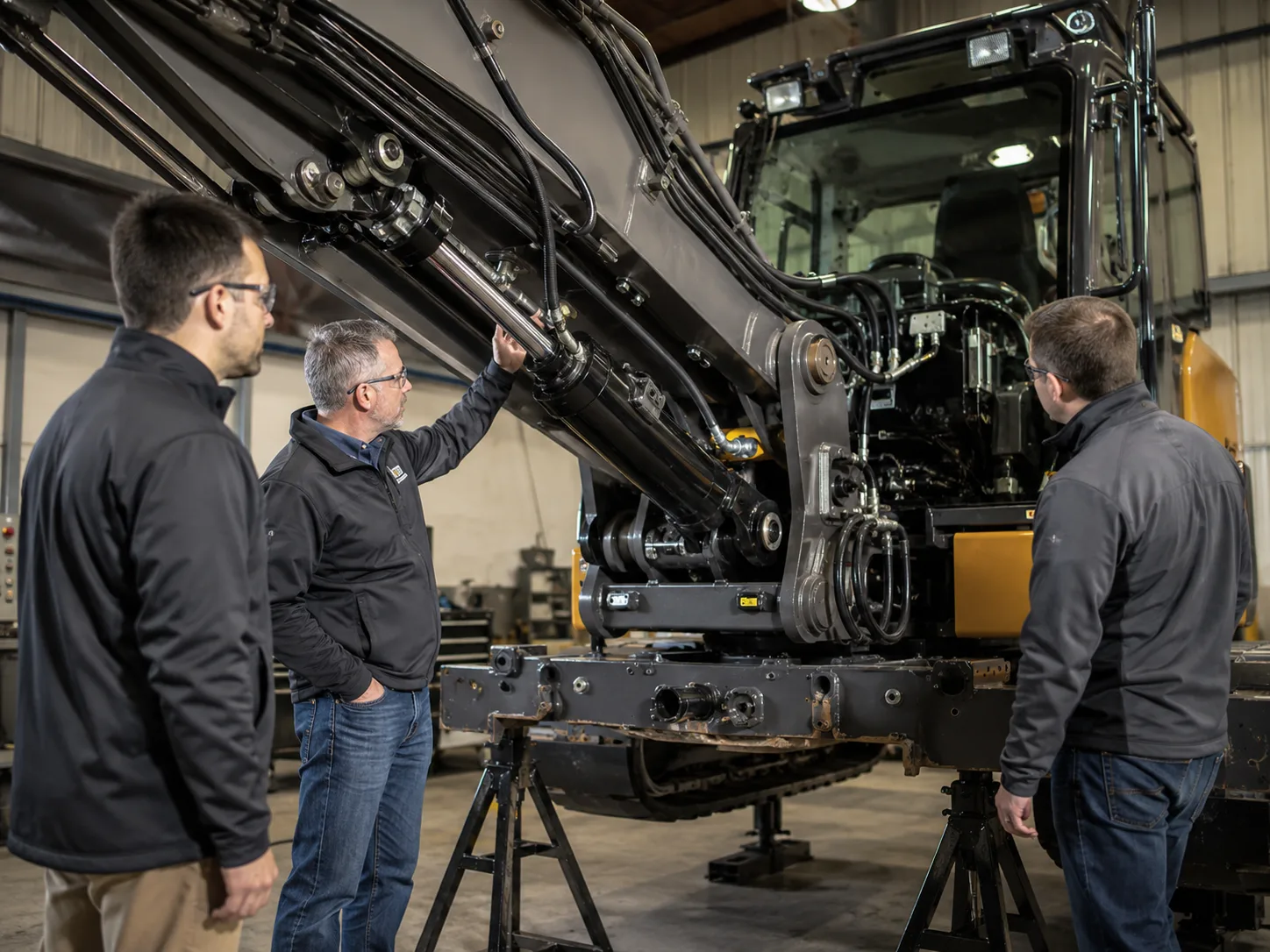
Mounting, stroke, and speed must be selected as one mechanical system. A cylinder that is strong enough on paper can still fail if the mount introduces side load, the stroke bottoms out against the machine frame, or the oil flow cannot support the required cycle time.
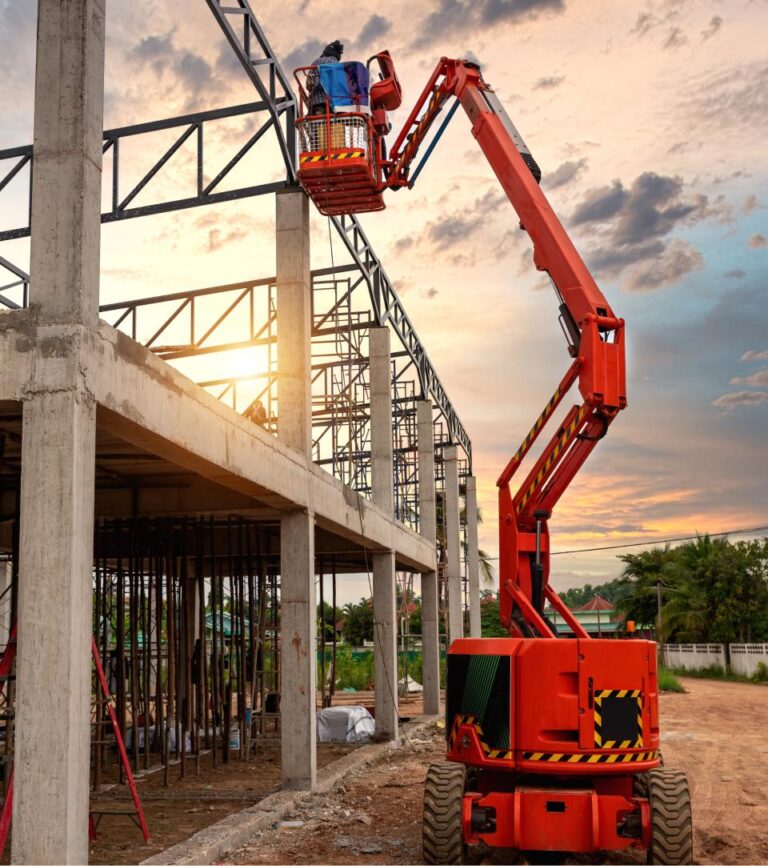
Clevis and spherical bearing mounts are common where the cylinder pivots through an arc, such as loaders, agricultural implements, dump bodies, and access platforms. Flange and foot mounts are better for more linear guided motion, but they demand careful alignment. Trunnion mounts can reduce bending moment when placed near the load path, yet incorrect trunnion location can make installation difficult and increase stress.
Stroke should be confirmed by machine geometry, not only by the old cylinder label. For replacement, measure fully retracted pin center distance and fully extended pin center distance if it is safe to do so. For OEM design, model the end positions and add clearance so the cylinder does not become the hard mechanical stop unless it is specifically designed for that duty.
Speed follows oil flow and effective area. A larger bore gives more force but requires more oil per millimeter of travel. If pump flow remains unchanged, increasing bore slows the extension speed. If speed is critical, such as in automated presses or lifting equipment with productivity targets, the buyer should provide target extend and retract times. Suppliers can then check port size, cushion design, seal friction, and heat generation.
Cushioning is also a purchasing decision. End-of-stroke cushions reduce impact when a load decelerates near the end of travel. They are valuable for repeated high-speed motion, but they add complexity and require adjustment. If the machine already has external flow control or proportional valves, the cylinder cushion should be specified to work with that control strategy rather than against it.
Which materials, seals, and environments change the buying decision?
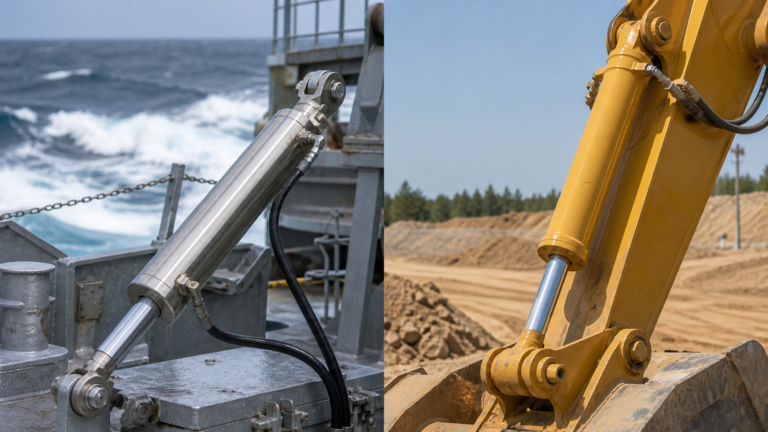
Material and seal decisions should follow the operating environment, not only the catalog default. Indoor industrial equipment, mobile construction machinery, marine exposure, agricultural dust, high-temperature process areas, and food or clean manufacturing zones each create different failure modes.
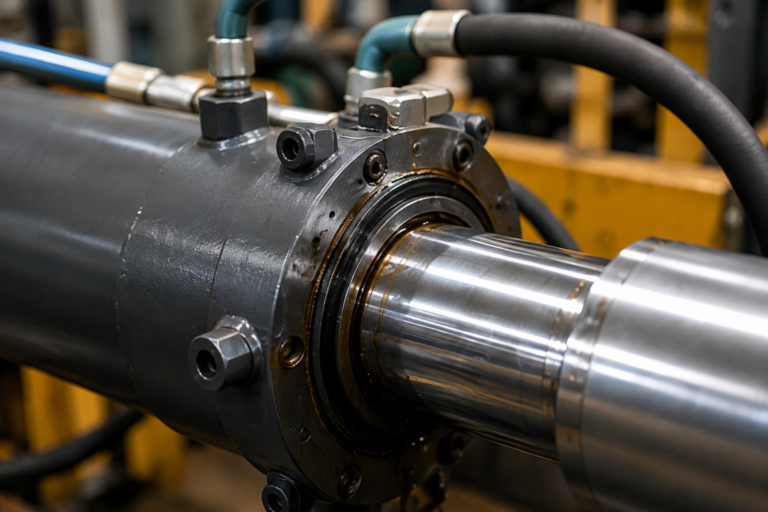
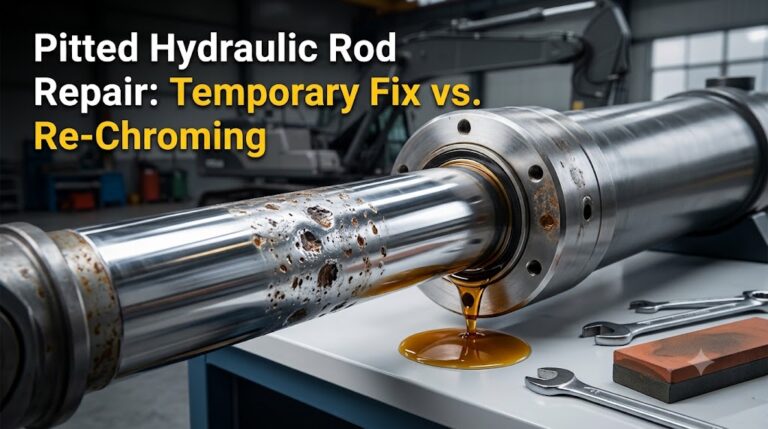
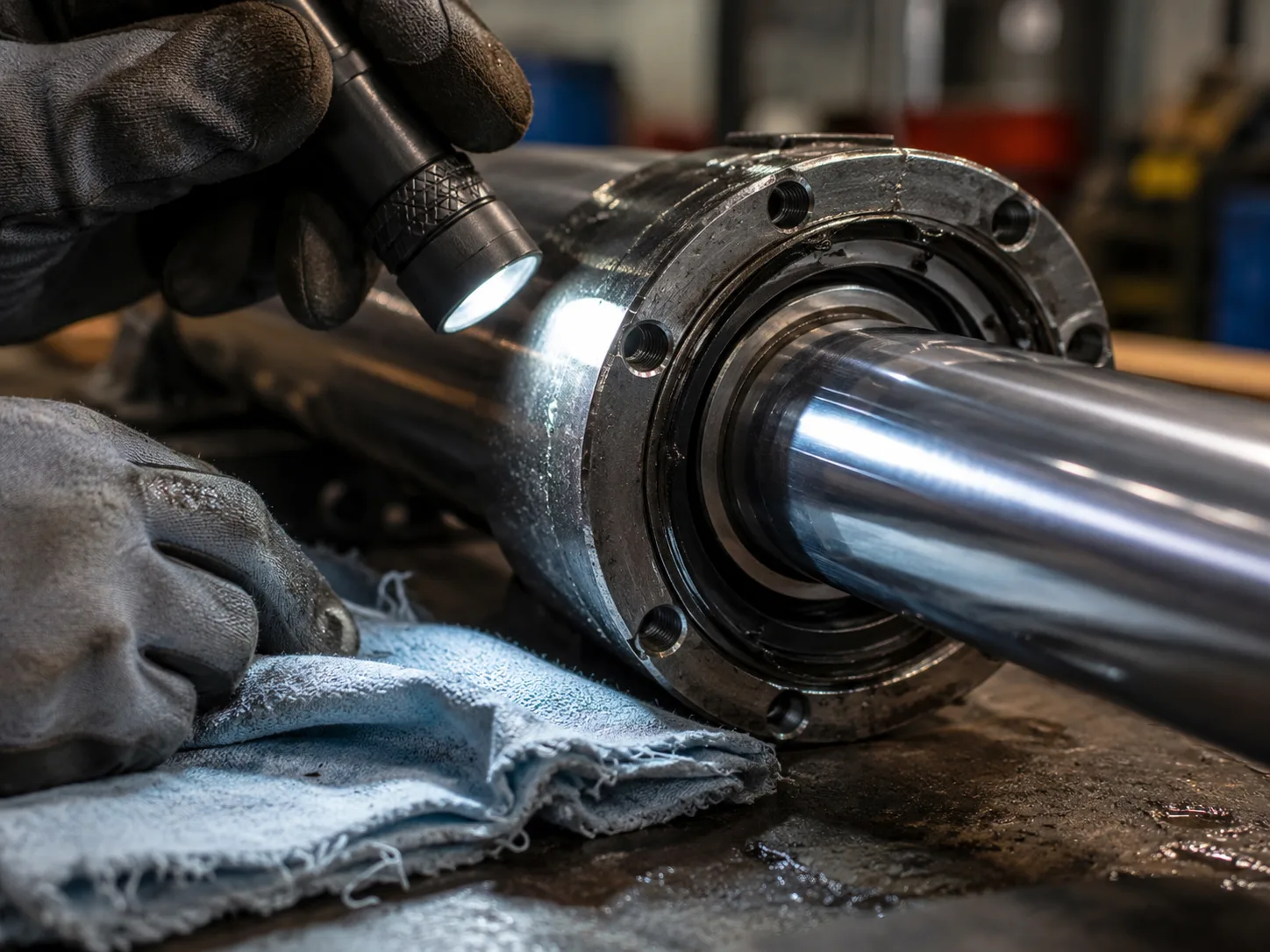
Most industrial hydraulic cylinders combine a steel tube, piston rod, piston, gland, and sealing system. Rod surface condition is especially important because the rod passes through the wiper and rod seal on every cycle. If the rod pits, scratches, or carries abrasive dirt into the gland, seal life drops quickly. Outdoor equipment often needs improved rod coating, paint protection, wipers suited for contamination, and packaging that prevents corrosion during storage and shipment.
Seal material should match fluid and temperature. NBR is widely used for mineral hydraulic oils in moderate temperature ranges. Polyurethane is common where wear resistance and extrusion control matter. FKM may be chosen for higher temperature or specific chemical resistance, while PTFE-based seal elements are used where low friction or special media compatibility is required. The buyer should always state hydraulic fluid type, expected temperature range, and whether the cylinder will face pressure spikes or long holding periods.
Regulatory and standards context matters for safety-related machinery. ISO 4413:2010 provides general rules and safety requirements for hydraulic fluid power systems and components. ISO 6020-2 and ISO 6022 define mounting dimensions for certain metric hydraulic cylinder series, supporting interchangeability where the machine design follows those standards. ISO 3320 covers cylinder bore and rod diameter series. These standards do not replace application engineering, but they give buyers a common dimensional language for supplier discussion.
| Application environment | Specification priority | Recommended buyer request | Commercial consequence |
|---|---|---|---|
| Indoor factory automation | Repeatability, leakage control, clean assembly | Ask for test pressure, stroke tolerance, seal type, and cleanliness handling. | Lower downtime risk and easier maintenance planning. |
| Construction or agricultural machinery | Rod protection, wiper performance, shock resistance | Specify mud, dust, impact, outdoor storage, and duty cycle. | Better field durability and fewer warranty claims. |
| Marine or coastal equipment | Corrosion resistance and coating durability | State salt exposure, washdown, paint requirement, and rod coating expectation. | Reduced seal damage caused by rod corrosion. |
| High-temperature process area | Seal and fluid compatibility | Provide actual ambient and oil temperature ranges before quotation. | Avoids early hardening, leakage, and unplanned shutdown. |
How to use this table: match the first column to the real working environment before comparing unit price; when two applications overlap, choose the harsher environmental specification because corrosion, heat, and contamination usually drive field failures faster than nominal load alone.
How do OEM and replacement buyers compare suppliers?
Supplier comparison should focus on engineering confirmation, process control, and after-sales traceability before small price differences. A low quotation is not useful if the supplier cannot verify calculations, hold dimensions across batches, test leakage, or reproduce the same cylinder six months later.
For OEM buyers, the supplier should be able to discuss drawings, manufacturability, welding quality, tube honing, rod coating, seal sourcing, assembly cleanliness, inspection records, and packaging. For replacement buyers, the supplier should help reverse-engineer missing specifications from photos and measurements, then identify where exact interchange is essential and where an equivalent design is acceptable.
A credible quotation should state bore, rod, stroke, pressure rating, mounting, port, seal material, surface treatment, testing basis, lead time, packing, Incoterms if international, and drawing approval status. If a quotation only lists “hydraulic cylinder” with a price, it is not enough for procurement approval. ZHY recommends engineering confirmation before quotation when the buyer lacks complete specs, especially for long-stroke cylinders, mobile machinery, or safety-sensitive lifting functions.
Industry trends also favor more detailed sourcing. OEMs are asking for better batch consistency, faster prototype-to-production transition, improved corrosion protection for export equipment, and clearer inspection documentation. Replacement buyers are also becoming more measurement-driven because downtime cost often exceeds the part price. In that context, a supplier who asks technical questions before quoting is usually reducing risk, not delaying the order.
Practical Asset: Copy-ready hydraulic cylinder inquiry checklist
Use this checklist before sending an inquiry to any supplier. It is designed to prevent the most common mistake: ordering from incomplete specifications and discovering force or installation mismatch only after delivery.
- State the application first: machine type, cylinder function, load direction, and whether the order is OEM development, repeat production, or replacement.
- Provide working pressure and maximum relief pressure if known; if unknown, send pump or valve nameplate information and the machine model.
- Measure bore evidence where possible, rod diameter, stroke, retracted pin-center length, extended pin-center length, pin diameter, mount width, and mounting hole details.
- Photograph the cylinder from the rod end, base end, port side, full machine installation, and hose routing side; include a ruler or caliper in close-up photos.
- Confirm mounting type and rod end connection: clevis, eye, spherical bearing, flange, trunnion, threaded rod, or custom bracket.
- List port standard and port orientation; if unknown, send thread photos and measure outside diameter, pitch, and sealing face type.
- Specify speed expectation: target extension time, retraction time, pump flow if available, and whether cushioning is required.
- Describe environment: indoor or outdoor use, dust, mud, salt, washdown, ambient temperature, oil temperature, and storage conditions before installation.
- Ask the supplier to confirm force calculation, mounting compatibility, rod buckling risk for long stroke, seal selection, surface protection, and test method before final quotation.
- Request a drawing for approval before production, especially when the cylinder is customized or replacing an imported machine part with no original drawing.
This workflow gives procurement, engineering, and supplier teams the same facts. It also makes price comparison more honest because each supplier is quoting the same cylinder duty, not filling missing details with different assumptions.
FAQ
1. What is the first step in choosing a hydraulic cylinder?
The first step is to confirm the required load and the available system pressure. Bore size should be calculated from those two values before discussing price or delivery. If the load is unknown, identify the machine function, linkage geometry, lifting weight, friction, and worst working angle. ISO 4413:2010 emphasizes safety requirements for hydraulic systems and components, so buyers should avoid forcing a cylinder to compensate for uncertain machine data.
2. How do I know if a replacement hydraulic cylinder will fit?
A replacement cylinder will fit only if both performance and interface dimensions match. Measure stroke, retracted length, extended length, pin diameter, mount width, port thread, rod diameter, and base-end and rod-end geometry. Photos are useful, but measurements are essential. If the old cylinder has no drawing, send installation photos and dimensions to the supplier for confirmation. Small differences in clevis width or port orientation can create installation problems even when bore and stroke look correct.
3. Should I choose a larger bore for extra safety?
A larger bore can increase extension force at the same pressure, but it is not always the safer choice. It also increases oil volume, may slow cycle time, and can apply higher force to brackets, pins, and machine structures. The better method is to calculate the required force, add a justified margin, verify relief pressure, and check the mechanical structure. Oversizing without system review can shift the failure point from the cylinder to the machine frame.
4. Which seal material is best for hydraulic cylinders?
There is no single best seal material for every cylinder. NBR is widely used with mineral hydraulic oils in moderate conditions, polyurethane is common for wear resistance, FKM is selected for higher temperature or chemical resistance, and PTFE-based elements can support low-friction or special compatibility needs. The buyer should provide hydraulic fluid type, oil temperature, ambient temperature, speed, contamination level, and holding pressure. Seal choice should be confirmed before quotation when the cylinder works outdoors or near heat.
5. What information should I send to ZHY before asking for a quote?
Send the application, quantity, bore if known, rod diameter, stroke, working pressure, mounting type, pin dimensions, port type, seal environment, speed requirement, and photos or drawings. If you are not sure how to choose hydraulic cylinder specifications, start with load and available pressure, then ask for engineering confirmation. ZHY can review whether the bore, mounting, stroke, seals, and surface protection are suitable before preparing a formal quotation.
References
- ISO 4413:2010 Hydraulic fluid power — General rules and safety requirements for systems and their components, International Organization for Standardization, 2010.
- ISO 6020-2:2015 Hydraulic fluid power — Mounting dimensions for single rod cylinders, 16 MPa series — Part 2: Compact series, International Organization for Standardization, 2015.
- ISO 6022:2018 Hydraulic fluid power — Mounting dimensions for single rod cylinders, 25 MPa series, International Organization for Standardization, 2018.
- ISO 3320:2013 Fluid power systems and components — Cylinder bores and piston rod diameters and area ratios — Metric series, International Organization for Standardization, 2013.
- Hydraulic Cylinders: Basics of Design, Function, and Construction, Brendan Casey, Machinery Lubrication, Noria Corporation, 2019.
- Hydraulic Cylinder Troubleshooting, Brendan Casey, Machinery Lubrication, Noria Corporation, 2019.
- Hydraulic Cylinders, Power & Motion Editors, Power & Motion, Endeavor Business Media, 2023.
- Fluid Power Data and Industry Resources, National Fluid Power Association, 2024.
How this guide closes the buying decision
A hydraulic cylinder purchase becomes predictable when the buyer treats it as a force-and-fit decision before treating it as a price decision. The practical sequence is clear: define the load, confirm available pressure, calculate bore, verify rod diameter and buckling risk, choose stroke from machine geometry, select mounting from movement path, then specify seals and protection from the environment. This order is more reliable than starting with catalog size because it mirrors how the cylinder actually fails or succeeds in service.
The main reason this matters is that hydraulic cylinders are not isolated parts. They interact with pumps, valves, hoses, pins, brackets, machine frames, operators, and maintenance habits. ISO 4413:2010 frames hydraulic systems around safety and component requirements, while ISO 6020-2, ISO 6022, and ISO 3320 provide dimensional language that helps buyers and suppliers communicate. Standards support the decision, but they do not remove the need to verify real load cases, mounting clearance, and working environment.
The best option for an OEM buyer is to request engineering review before production quotation, especially when the project involves custom mounts, export equipment, long stroke, harsh outdoor use, or repeat production. The best option for a replacement buyer is to combine measurements with photos and avoid assuming that visual similarity equals interchangeability. A cylinder with the correct bore but the wrong pin-center length, port angle, or rod-end width can stop a repair just as completely as a wrong pressure rating.
Market behavior is moving toward more documented sourcing because downtime, warranty claims, and international replacement complexity make incomplete specifications costly. Buyers who provide pressure, force, stroke, mounting, seal environment, and inspection expectations receive more comparable quotations and fewer surprises. In commercial terms, the winning supplier is not simply the one who answers fastest; it is the one who confirms the technical assumptions before accepting the order. That is why the safest next step is not “quote by diameter,” but “confirm the cylinder specification package, then quote.”