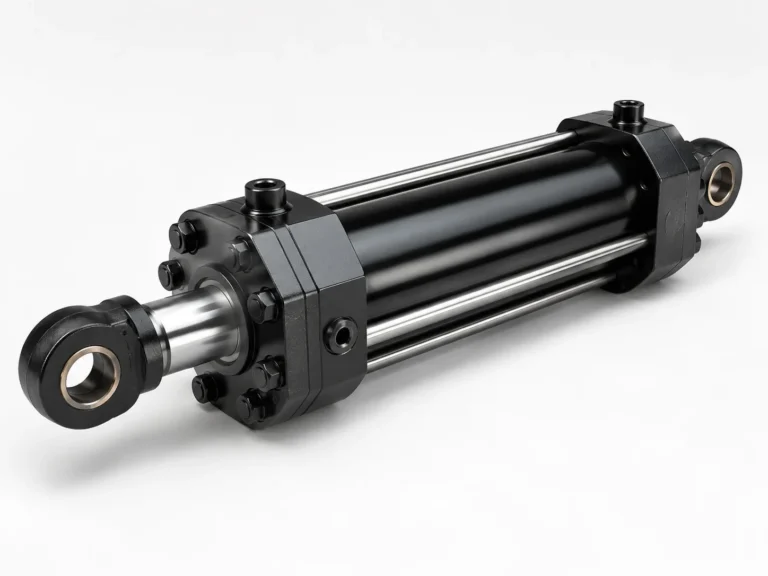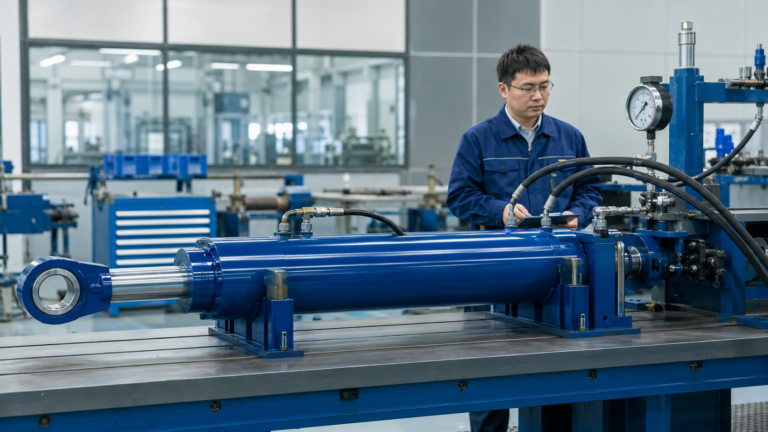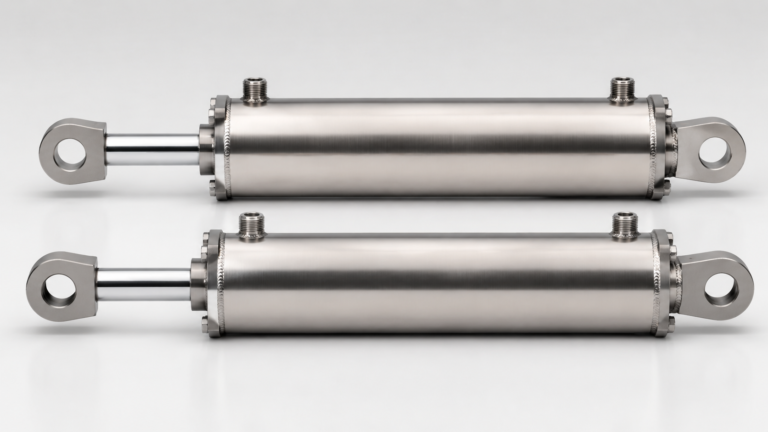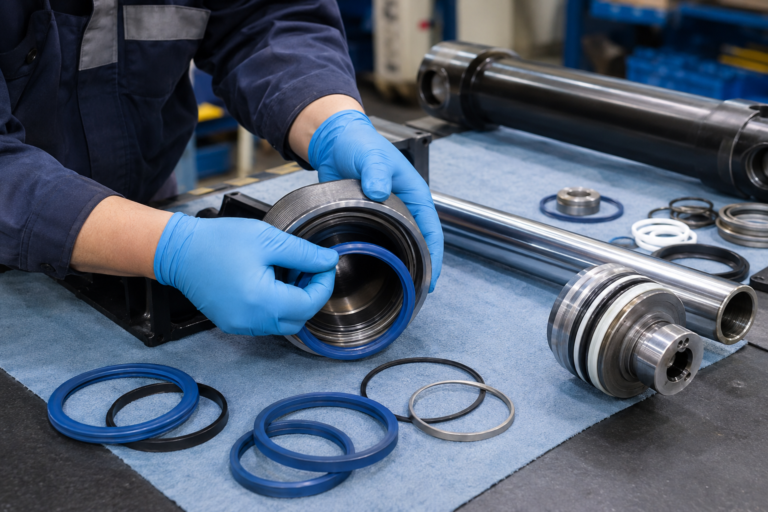
Hydraulic cylinder bore size determines how much push or pull force a cylinder can produce at a given pressure. Choose a bore that is too small and the cylinder may stall; choose one that is unnecessarily large and the system becomes slower, heavier, and more expensive. This guide shows the bore-size formula, explains the difference between extension and retraction force, and walks through practical sizing examples in both metric and US customary units.
Quick formula: first calculate the piston area with A = F / P, then calculate bore diameter with D = √(4A / π). Use consistent units, add an engineering safety factor, and round up to the next standard bore size.
Hydraulic Cylinder Bore Size Formula
For a double-acting hydraulic cylinder extending under pressure, the theoretical force is:
F = P × A
Where:
- F = cylinder force
- P = hydraulic pressure
- A = effective piston area
Because the piston area is circular:
A = πD² / 4
Rearranging these equations gives the required bore diameter:
D = √(4F / πP)
This is the core hydraulic cylinder bore calculation. It gives a theoretical minimum diameter before friction, pressure losses, load variation, acceleration, side loading, and safety margin are considered.
Metric Formula: Force in Newtons and Pressure in Bar
In SI calculations, pressure in pascals and dimensions in meters are mathematically direct. In practical cylinder selection, however, engineers commonly use force in kilonewtons, pressure in bar, and bore in millimeters.
Use:
A (mm²) = F (N) × 10 / P (bar)
Then:
D (mm) = √[4 × A (mm²) / π]
Or combine the steps:
D (mm) = √[40 × F (N) / (π × P (bar))]
Metric example: 100 kN at 160 bar
- Convert force: 100 kN = 100,000 N.
- Required area: A = 100,000 × 10 / 160 = 6,250 mm².
- Required bore: D = √(4 × 6,250 / π) = 89.2 mm.
- Round up to a standard bore, typically 100 mm.
A 90 mm theoretical result should not automatically be treated as a 90 mm production specification. A 100 mm bore gives useful reserve for seal friction and real system losses. At 160 bar, its theoretical extension force is approximately 125.7 kN.
US Formula: Force in Pounds and Pressure in PSI
When force is in pounds-force and pressure is in psi:
A (in²) = F (lbf) / P (psi)
D (in) = √[4F / (πP)]
US example: 20,000 lbf at 2,500 psi
- Required area: A = 20,000 / 2,500 = 8 in².
- Required bore: D = √(4 × 8 / π) = 3.19 in.
- Round up to the next suitable standard bore, such as 3.25 or 3.5 inches, subject to the available cylinder series and design margin.
Extension Force vs. Retraction Force
A double-acting cylinder does not produce the same force in both directions. During extension, pressure acts on the full piston area. During retraction, the rod occupies part of that area, so pressure acts on the smaller annular area.
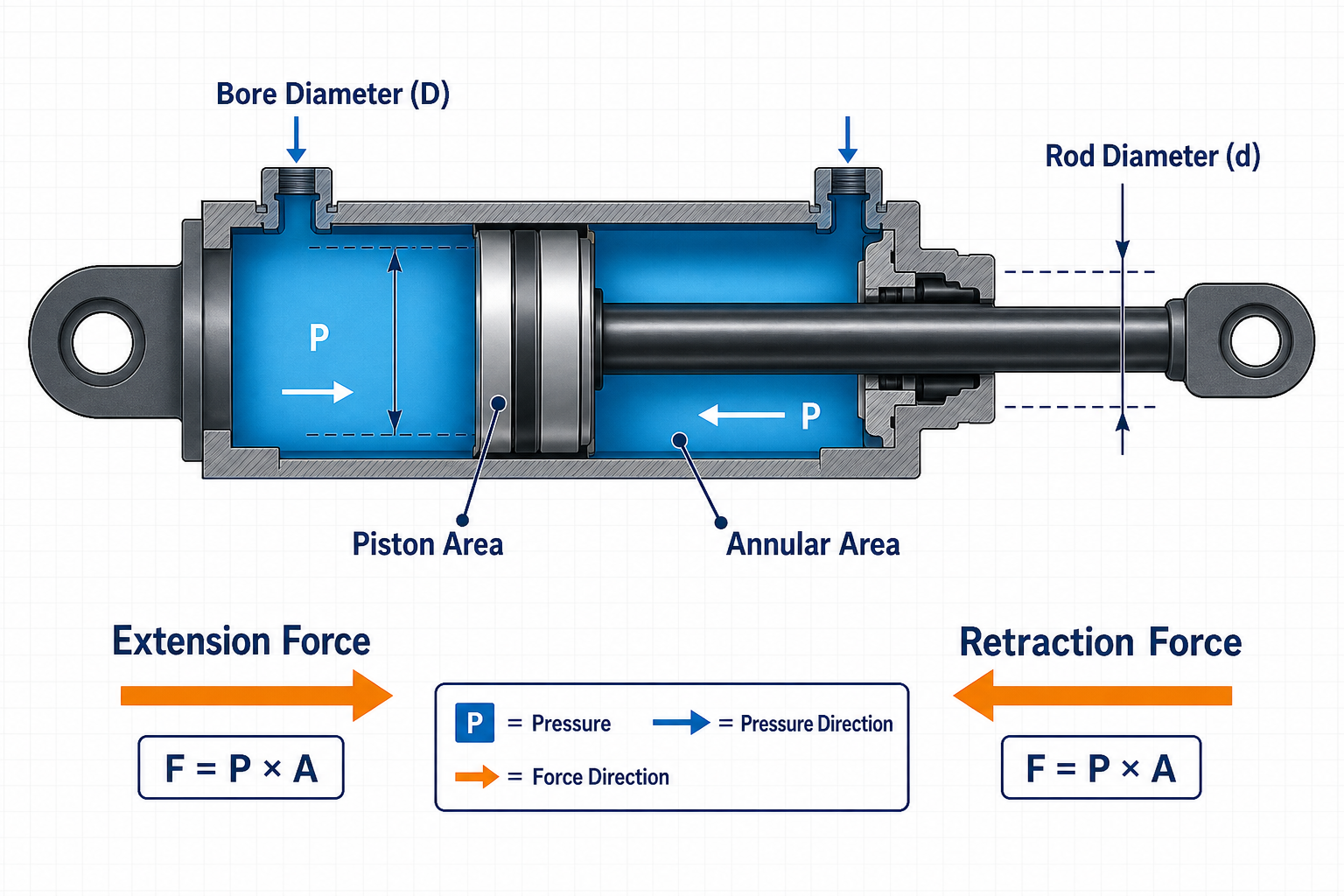
Extension area: Aextend = πD² / 4
Rod area: Arod = πd² / 4
Retraction area: Aretract = π(D² − d²) / 4
Retraction force: Fretract = P × Aretract
Here, D is bore diameter and d is rod diameter. If the machine must pull a heavy load, size the cylinder using retraction force rather than extension force. Our related guide on how to calculate hydraulic cylinder pressure and load explains the reverse calculation when bore and load are already known.
Add a Safety Factor Before Selecting the Bore
Theoretical force assumes ideal pressure at the cylinder and ignores friction. Real equipment does not operate under ideal conditions. A practical design should account for seal drag, valve and hose pressure losses, pump tolerance, load spikes, temperature, misalignment, and mechanical efficiency.
A common approach is:
Design force = Required load × Safety factor
For stable, well-guided industrial loads, a factor around 1.25 may be reasonable. Variable loads, mobile equipment, shock, uncertain friction, or safety-critical motion may require 1.5, 2.0, or a value specified by the applicable engineering standard. The correct factor must come from a machine-level risk assessment, not from a generic calculator.
After applying the factor, repeat the bore calculation and select the next larger standard size. Also confirm that the cylinder’s rated working pressure and proof pressure are suitable. See our overview of hydraulic cylinder working pressure for pressure-rating considerations.
Standard Bore Size Selection
Calculated bore diameter is rarely the final catalogue size. Common metric bores include 25, 32, 40, 50, 63, 80, 100, 125, 160, and 200 mm, although manufacturers and standards vary. Common inch sizes include 1.5, 2, 2.5, 3, 3.25, 3.5, 4, 5, 6, and 8 inches.
Always round up, then recalculate force at the actual bore. Do not round down simply because the result is close. If the larger bore produces excessive speed reduction or oil demand, reassess system pressure, load geometry, cylinder mounting, or the number of cylinders.
Pressure, Bore, Speed, and Flow Trade-Offs
A larger bore creates more force at the same pressure, but it also requires more oil for the same stroke. Cylinder speed is governed by:
Velocity = Flow rate / Effective area
Therefore, increasing bore without increasing pump flow reduces extension speed. It also increases displaced oil volume, reservoir and valve requirements, cylinder weight, and often cost. Good sizing balances force reserve with acceptable cycle time and available hydraulic power.
If you are selecting the complete actuator rather than only the bore, use our broader hydraulic cylinder sizing guide to check stroke, rod diameter, buckling, mounts, ports, seals, and operating environment.
Five-Step Bore Sizing Method
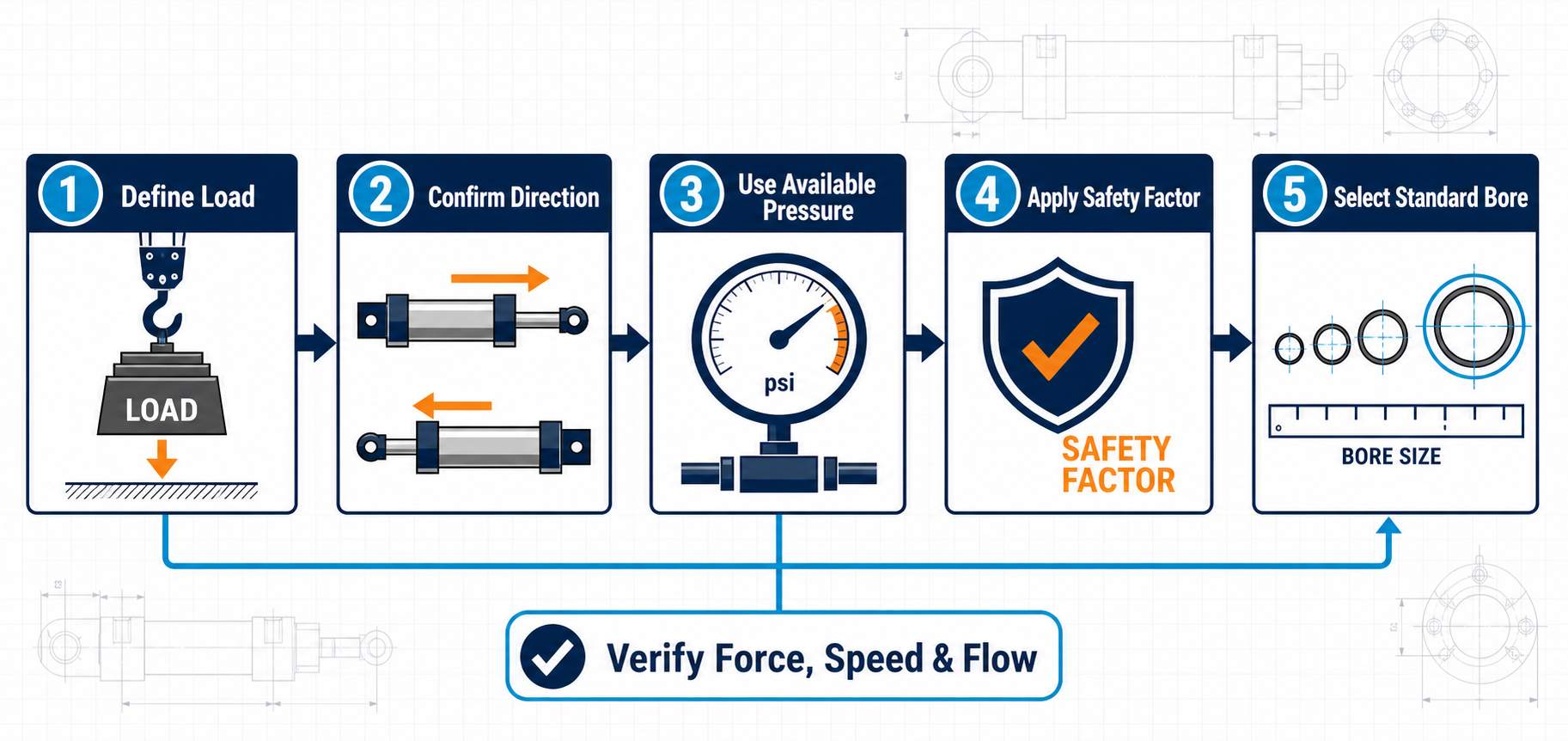
- Define the worst-case load. Include tooling, payload, friction, gravity, and the effect of levers or linkage geometry.
- Choose the correct motion direction. Use full piston area for pushing on extension and annular area for pulling on retraction.
- Use minimum available cylinder pressure. Do not use only the pump’s nominal or relief setting; subtract expected system losses.
- Apply an appropriate safety factor. Base it on load uncertainty, duty, shock, guidance, and consequences of failure.
- Round up and verify the whole design. Check actual force, rod buckling, speed, flow, mounting, pressure rating, and duty cycle.
Common Bore-Size Calculation Mistakes
- Mixing units: bar is not N/mm², and psi must be paired with lbf and square inches.
- Using pump pressure instead of cylinder pressure: hoses, valves, filters, and flow controls create losses.
- Ignoring retraction area: pull force is lower because of the rod area.
- Ignoring load geometry: a cylinder connected through a lever may need much more force at some positions.
- Using theoretical force as guaranteed force: friction and efficiency reduce usable output.
- Skipping rod checks: the bore controls force, but the rod must resist compression, buckling, fatigue, and side load.
- Oversizing by default: excessive bore can create slow motion, high oil consumption, and larger components throughout the circuit.
Worked Check: 100 mm Bore at 160 Bar
For a 100 mm bore:
A = π × 100² / 4 = 7,854 mm²
At 160 bar:
F = 160 × 7,854 / 10 = 125,664 N ≈ 125.7 kN
If the cylinder has a 56 mm rod, the retraction area is:
Aretract = π × (100² − 56²) / 4 ≈ 5,391 mm²
Retraction force at 160 bar is approximately 86.3 kN before losses. This comparison shows why bore and rod diameter must be evaluated together.
FAQ: Hydraulic Cylinder Bore Size
How do I calculate the bore size of a hydraulic cylinder?
Divide the required design force by available pressure to obtain piston area, then calculate diameter with D = √(4A/π). Keep units consistent, account for losses, apply a safety factor, and round up to a standard bore.
How much force does a 4-inch hydraulic cylinder produce?
A 4-inch bore has an area of about 12.57 in². Theoretical extension force is about 25,133 lbf at 2,000 psi and 37,699 lbf at 3,000 psi. Actual usable force will be lower because of pressure losses and friction.
Should I size a cylinder using maximum or working pressure?
Use the minimum pressure realistically available at the cylinder during the required movement. Maximum or relief pressure is a protection limit and may not be continuously available for useful work.
Why is cylinder pull force lower than push force?
During retraction, the piston rod reduces the pressurized area. Pull force is calculated from the annular area: piston area minus rod area.
Can I increase pressure instead of choosing a larger bore?
Only if the pump, valves, hoses, fittings, cylinder tube, end caps, seals, and machine structure are rated for the higher pressure. Never exceed the cylinder’s rated working pressure.
Final Sizing Checklist
- Required push and pull force confirmed
- Minimum pressure at the cylinder confirmed
- Load geometry and friction included
- Safety factor documented
- Standard bore rounded up and actual force recalculated
- Rod diameter and buckling checked
- Stroke, speed, flow, ports, mounts, and duty cycle verified
- Working pressure, test pressure, and applicable standards confirmed
Correct hydraulic cylinder bore size starts with force and pressure, but it ends with a complete system check. For OEM or replacement applications, provide the load, operating pressure, stroke, mounting arrangement, required speed, duty cycle, and environment to the cylinder manufacturer. If you need help turning those requirements into a production specification, review our guide on how to choose a hydraulic cylinder.