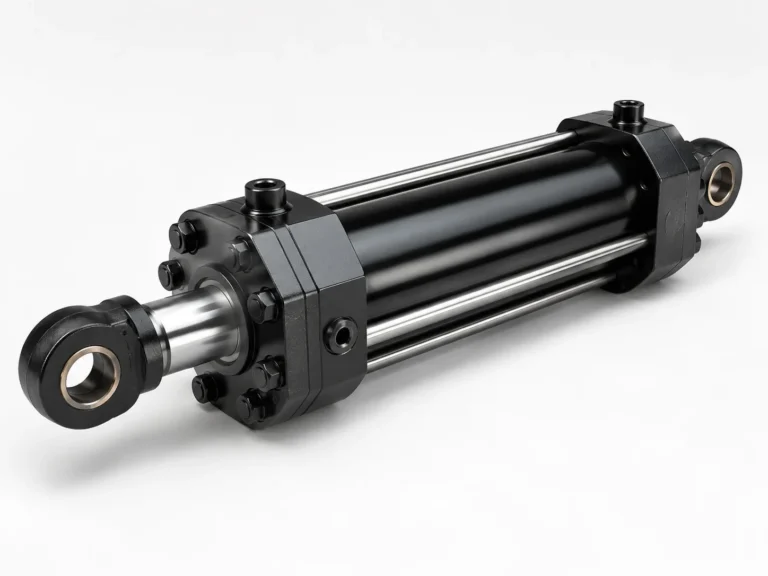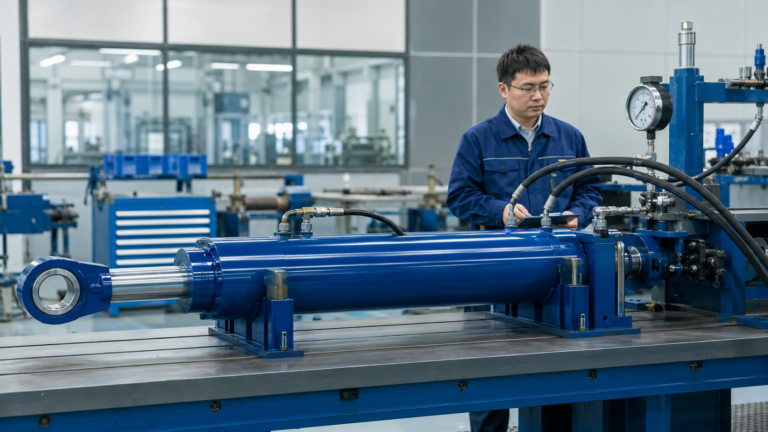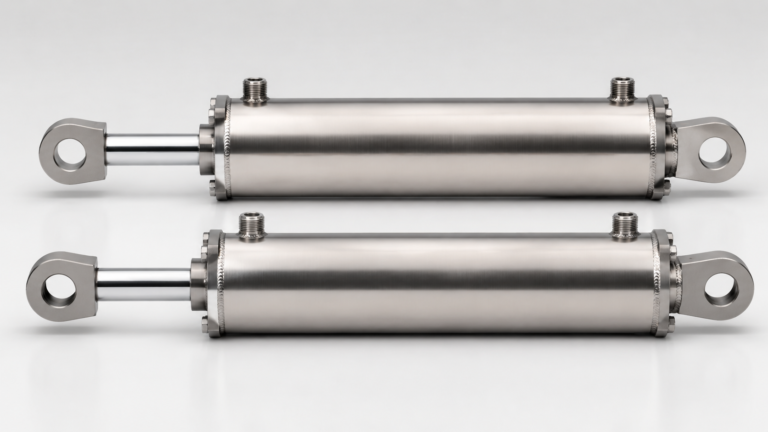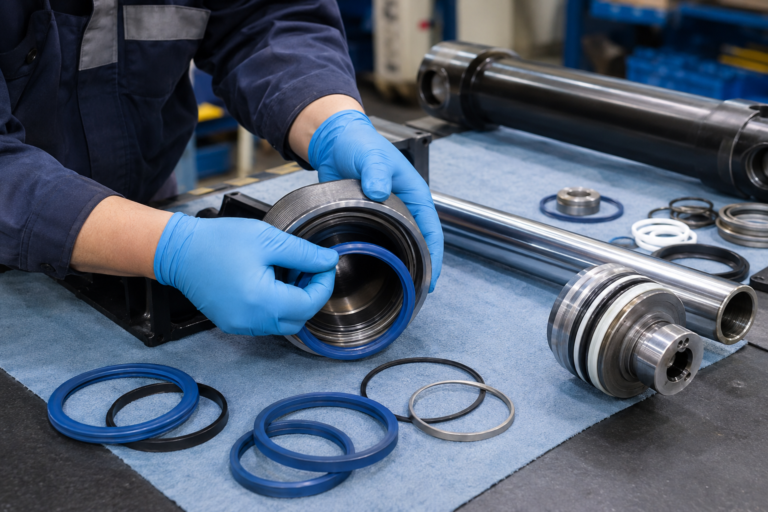
A hydraulic cylinder can look perfect on the day it leaves the factory and still become the wrong material choice six months later. The usual reason is simple: stainless steel was specified, but the environment was not.
For most OEM projects, the real decision is 304 vs 316 stainless steel hydraulic cylinders. Both grades are corrosion-resistant, weldable, and widely available. However, 316 contains molybdenum, which gives it better resistance to chloride-driven pitting and crevice corrosion. That difference matters around salt spray, seawater mist, washdown chemicals, and some process fluids.
Quick Answer: Should You Choose 304 or 316?
Choose 304 stainless steel for indoor equipment, dry production areas, mild humidity, and general food or packaging machinery where chlorides are low and routine cleaning is controlled.
Choose 316 stainless steel for coastal equipment, salt spray, frequent washdown, wastewater, marine deck machinery, and chemical exposure where chloride-related corrosion is a realistic risk.
Do not assume 316 is automatically suitable for continuous seawater immersion, hot concentrated chlorides, or every chemical. Those conditions may require 316L, duplex 2205, a higher-alloy material, coatings, or application-specific corrosion testing.
Key Takeaways
- 304 and 316 are both austenitic stainless steels with similar general mechanical behavior.
- 316 normally contains about 2–3% molybdenum; 304 generally does not.
- Molybdenum improves resistance to chloride pitting and crevice corrosion.
- 304 usually costs less and is often sufficient for controlled indoor service.
- 316 reduces corrosion risk in coastal, washdown, wastewater, and some chemical environments.
- The cylinder rod, welds, ports, fasteners, seals, and mounting pins must match the environment too.
- The correct choice depends on exposure, temperature, cleaning chemicals, duty cycle, surface finish, and maintenance—not the grade name alone.
304 vs 316 Stainless Steel Hydraulic Cylinders at a Glance
| Selection Factor | 304 Stainless Steel | 316 Stainless Steel | Buyer Impact |
|---|---|---|---|
| Typical alloy difference | Chromium-nickel austenitic grade | Chromium-nickel grade with about 2–3% molybdenum | 316 has stronger localized-corrosion resistance. |
| Chloride resistance | Suitable for low-chloride, mild exposure | Better for salt, brine, and chloride-bearing washdown | Choose 316 when salt deposits can remain on the cylinder. |
| Typical environments | Indoor machinery, packaging, controlled food production | Coastal, marine splash, wastewater, frequent washdown | Match the grade to actual exposure, not the industry label. |
| Cost | Usually lower | Usually higher | 304 can lower initial cost when corrosion risk is genuinely mild. |
| Welded fabrication | 304L often preferred for welded parts | 316L often preferred for welded parts | Low-carbon grades help reduce sensitization risk near welds. |
| Best purchasing logic | Controlled environment and value-focused design | Higher corrosion margin and lower field-maintenance risk | Compare lifecycle cost, not material price alone. |
What Is the Real Difference Between 304 and 316?
The most important difference is not appearance. A polished 304 cylinder and a polished 316 cylinder can look almost identical. The practical difference is alloy chemistry.
Both grades rely on chromium to form a thin passive oxide layer. Outokumpu’s atmospheric-corrosion guidance notes that alloying additions and localized-corrosion risk should guide stainless selection. When that layer remains intact, it protects the steel from general corrosion. Grade 316 adds molybdenum, improving resistance to localized attack—especially pitting and crevice corrosion in chloride-containing environments.
World Stainless corrosion guidance explains why grade selection must account for localized corrosion and service conditions. This is why 316 is often called “marine grade.” The nickname is useful, but it is not a guarantee. Temperature, chloride concentration, deposits, stagnant moisture, surface finish, welding quality, and oxygen availability can still cause corrosion. Even 316 can pit in aggressive seawater or hot chloride service.
When Is a 304 Stainless Steel Hydraulic Cylinder the Better Choice?
When comparing 304 vs 316 stainless steel hydraulic cylinders, start by asking whether chlorides are actually present.
304 is often the smarter choice when the cylinder operates indoors and does not see salt or aggressive chemicals. Buying 316 for every stainless cylinder may increase cost without improving machine performance.
Good Applications for 304
- Indoor packaging and handling machinery
- Clean factory automation
- Dry food-processing zones with controlled cleaners
- Pharmaceutical machinery outside aggressive washdown zones
- General outdoor equipment away from coastal salt
- Machines exposed mainly to humidity and fresh water
Specify 304 only after confirming the cleaning fluid, chloride level, temperature, and exposure frequency. A factory described as “food grade” may use chlorine-based sanitizers every shift. In that case, the cleaning process—not the product being manufactured—may make 316 the safer choice.
When Should You Choose a 316 Stainless Steel Hydraulic Cylinder?
The 304 vs 316 stainless steel hydraulic cylinders decision changes when salt deposits or chloride-bearing cleaners are part of daily service.
Choose 316 when chloride exposure is credible and the cost of corrosion is higher than the material premium. A cylinder installed outdoors near the sea may never touch seawater directly, yet airborne salt can settle in weld toes, mounting gaps, gland interfaces, and under hose clamps.
Applications That Commonly Favor 316
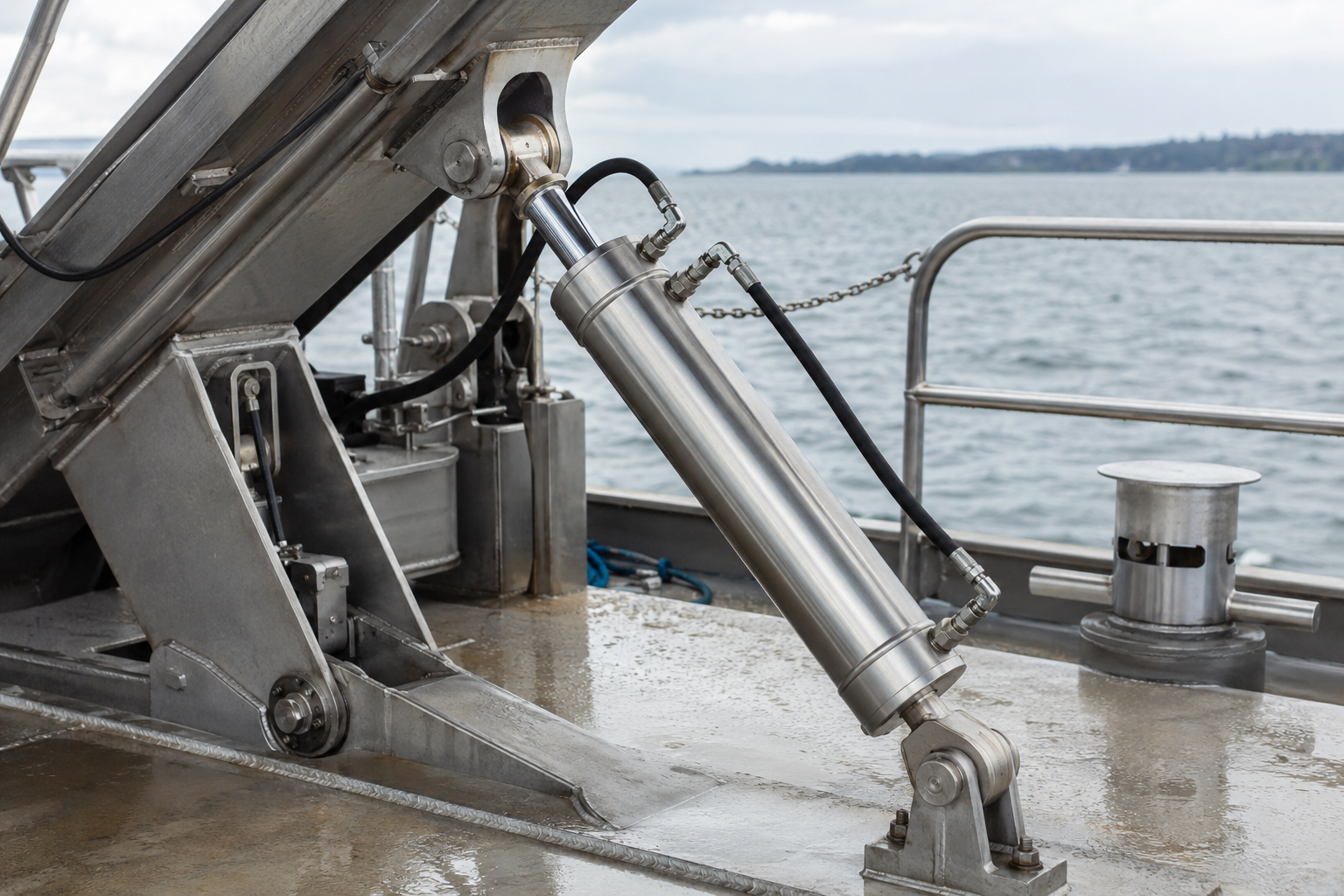
- Marine hydraulic cylinders for deck equipment, hatches, ramps, steering, and winches
- Coastal machinery exposed to airborne salt and condensation
- Wastewater and water-treatment equipment
- Food equipment with frequent chloride-bearing washdown
- Chemical-processing machinery with compatible process media
- Outdoor equipment where cleaning is infrequent and deposits remain wet
316 is a risk-reduction decision, not a substitute for application review. If the cylinder is continuously immersed, exposed to hot brine, or located in a stagnant crevice, ask for a corrosion assessment instead of relying on the 316 label.
Why the Entire Cylinder Must Be Specified—not Just the Barrel
A stainless tube does not create a corrosion-resistant cylinder by itself. The complete assembly includes the barrel, head, base, piston rod, ports, fittings, weld filler, fasteners, pins, bearings, seals, and protective surfaces. One mismatched component can become the failure point.
1. Piston Rod and Running Surface
The rod must resist both corrosion and seal wear. Depending on exposure and load, options may include stainless rod material, hard chrome plating, nickel-chrome systems, or other engineered coatings. Rod straightness, hardness, surface roughness, and coating integrity affect seal life.
2. Welds and Heat-Affected Zones
For welded cylinders, 304L or 316L is often selected because lower carbon content helps reduce sensitization risk. Correct filler selection, controlled heat input, cleaning, pickling, and passivation can matter as much as the base grade.
3. Ports, Fasteners, and Mounting Pins
Carbon-steel plugs or fasteners can corrode beside a stainless body. Dissimilar metals can also create galvanic-corrosion concerns when an electrolyte is present. Confirm every exposed component and the insulation or coating strategy where materials differ.
4. Seals and Hydraulic Fluid
Stainless steel does not protect a seal from incompatible oil, cleaning chemicals, heat, or pressure spikes. Seal material should be chosen according to the fluid, temperature, speed, pressure, and contaminants. Use our guide to select hydraulic cylinder seals as a separate engineering decision.
304L vs 316L: Does the “L” Matter?
The “L” identifies a lower-carbon version of the grade. In welded fabrications, lower carbon helps reduce chromium-carbide precipitation and the associated loss of corrosion resistance near welds. That is why 304L and 316L are common choices for welded cylinder components.
However, “L” does not mean stronger chloride resistance than the base alloy family. A 304L component is still a 304-family material and does not gain the molybdenum advantage of 316L. The decision remains two-part: first choose the alloy family for the environment, then choose the carbon grade and welding procedure for fabrication.
Selection Table by Operating Environment
Use this 304 vs 316 stainless steel hydraulic cylinders table as a starting point, then validate the real fluid and temperature.
| Operating Condition | Starting Choice | What You Must Confirm |
|---|---|---|
| Dry indoor industrial equipment | 304 / 304L | Cleaning agents, condensation, fluid compatibility |
| Fresh-water washdown | 304 or 316 | Chlorides in water and detergent, wash frequency, drying |
| Chlorinated food sanitation | 316 / 316L | Chemical concentration, dwell time, temperature, rinsing |
| Coastal outdoor machinery | 316 / 316L | Distance from shore, salt deposits, maintenance access |
| Marine splash or deck service | 316L as a starting point | Immersion, crevices, temperature, coating, galvanic couples |
| Hot brine or continuous seawater immersion | Engineering review required | Consider duplex or higher-alloy materials; test actual media |
Engineering Comparison: Corrosion Resistance Is Not the Same as Cylinder Strength
Material selection and cylinder sizing are separate decisions. The grade name does not determine whether the barrel, rod, weld, or mount can safely carry your load. Yield strength, tensile strength, hardness, wall thickness, buckling length, weld geometry, pressure cycles, and the supplied product condition must still be checked against the drawing.
A useful screening tool for chloride pitting is the Pitting Resistance Equivalent Number (PREN):
PREN = %Cr + 3.3 × %Mo + 16 × %N
Because 316 contains molybdenum, its PREN is normally higher than that of 304. This supports the practical conclusion that 316 has a larger chloride-pitting margin. However, PREN is a ranking tool—not a service-life calculator. It does not capture weld heat tint, surface contamination, crevice geometry, actual temperature, chloride concentration, cleaning practice, or galvanic contact.
Component-by-Component Material Strategy
A cost-effective cylinder does not always require one grade for every part. What matters is that the complete material system is documented and compatible with the exposure.
| Cylinder Component | Engineering Question | What to Put on the Drawing or PO |
|---|---|---|
| Barrel, head, and base | Are they exposed, wetted, welded, or pressure-retaining? | Exact grade, product form, heat treatment, dimensions, and traceability level |
| Piston rod | Will corrosion damage the seal-running surface? | Base material, coating system, hardness, thickness, roughness, and final diameter |
| Welds | Can heat tint or sensitization reduce local resistance? | Base grade, filler, welding qualification, heat-tint removal, and passivation requirement |
| Ports and fittings | Will trapped liquid or dissimilar metals create a local cell? | Material, thread, orientation, sealing method, and galvanic-isolation detail |
| Fasteners, pins, and bearings | Are these exposed and replaceable? | Grade, coating, lubrication, isolation, and replacement access |
| Seals and wiper | Can fluid, sanitizer, heat, or deposits attack the sealing system? | Elastomer/polymer, temperature range, fluid list, speed, pressure, and contamination controls |
Standards, Certificates, and Verification to Include in Your Purchase Order
“316 stainless” is not a complete acceptance requirement. The purchase order should connect each component to the appropriate material specification and inspection evidence. For example, ASTM A240/A240M covers stainless plate, sheet, and strip; other product forms such as bars, forgings, or tubes require their applicable specification.
- Material designation: state the exact grade or UNS/EN designation for each critical component.
- Material certificate: request an EN 10204 Type 3.1 inspection certificate when heat chemistry and mechanical results must be traceable. Define whether certificate traceability must continue from raw material to finished component.
- Positive material identification: PMI can help distinguish molybdenum-bearing 316 from 304. Common handheld XRF, however, may not reliably verify the low carbon that separates 316L from 316; confirm “L” grade through traceable chemistry or an appropriate carbon-analysis method.
- Welding records: for critical service, specify the required WPS/PQR, welder qualification, filler classification, and weld inspection.
- Cleaning and passivation: define fabrication cleaning, heat-tint removal, and acceptance. ASTM A380/A380M addresses cleaning, descaling, pickling, and passivation practices, while ASTM A967/A967M covers chemical passivation treatments and verification tests.
- Surface condition: state the required finish or roughness where hygiene, cleanability, or seal movement depends on it.
Standards must be tied to an edition and acceptance criteria agreed in the order. A certificate confirms the reported material properties; it does not prove that the finished cylinder will survive an undefined chemical environment.
A Practical Incoming-Inspection and Acceptance Plan
- Document review: match the material certificates, drawing callouts, heat numbers, welding records, and inspection report.
- Grade verification: perform PMI at the agreed components and sampling rate when mix-up risk justifies it.
- Surface inspection: check for embedded carbon-steel contamination, rust staining, heat tint, rough welds, coating damage, and moisture-trapping crevices.
- Dimensional inspection: verify bore-related dimensions, rod diameter, stroke, mounting centers, port orientation, and interfaces.
- Functional and pressure testing: confirm smooth travel, pressure holding, and external leakage according to the approved test plan.
- Application validation: when corrosion consequences are high, agree on a coupon test, chemical-compatibility review, prototype exposure trial, or other method based on the actual medium.
A pressure test verifies hydraulic integrity at the test condition. It does not validate chloride resistance or predict corrosion life. Keeping those two acceptance questions separate prevents a passed pressure test from creating false confidence.
Five Common Material-Selection Mistakes
Choosing by Industry Name
“Food,” “marine,” or “chemical” is not a complete specification. Two machines in the same industry can face completely different chloride levels and temperatures.
Specifying Only “Stainless Steel”
A supplier cannot reliably price or build the correct cylinder without a grade, product form, and component-by-component material list. Put the approved material designation on the drawing.
Ignoring Cleaning Chemicals
The production fluid may be mild while the sanitizer is aggressive. Obtain the cleaning chemical name, concentration, temperature, contact time, and rinse procedure.
Assuming 316 Cannot Rust
Deposits, embedded carbon-steel contamination, poor passivation, rough welds, and severe chlorides can attack 316. Proper fabrication and maintenance still matter.
Comparing Purchase Price Only
304 may save money initially. If it creates pitting, damaged seals, contamination, and field replacement, it becomes the expensive option. Compare downtime and maintenance exposure with the material premium.
What Information Should You Send With Your RFQ?
- Application and installation location
- Indoor, outdoor, coastal, splash, or immersion exposure
- Fluid and cleaning chemical names, concentrations, and temperatures
- Bore, rod diameter, stroke, retracted length, and mounting dimensions
- Normal pressure, peak pressure, test requirement, and duty cycle
- Required stainless grade for each wetted and exposed component
- Rod material, coating, hardness, and surface-finish requirement
- Seal material and hydraulic-fluid compatibility
- Port thread, port orientation, hose-clearance, and fitting material
- Welding, pickling, passivation, surface finish, and inspection requirements
If you are starting from an existing machine, send the drawing, sample dimensions, installation photos, corrosion photos, and failure history. A custom hydraulic cylinder should be specified around the real operating environment, not copied from an old unit that already failed.
How ZHY Hydraulic Helps You Choose 304 or 316
ZHY Hydraulic manufactures custom stainless steel hydraulic cylinders in 304, 316, 304L, and 316L configurations according to approved drawings and application requirements. We review environmental exposure together with bore, stroke, pressure, mounts, ports, rod surface, seals, welding, and testing.
For corrosive-service projects, the material callout should identify more than the barrel. We can confirm the component material list, manufacturing method, surface-treatment requirement, and inspection points before production. Each design is pressure-tested according to the confirmed drawing and test plan.
Need a 304 or 316 Stainless Cylinder?
Send your drawing, operating environment, pressure, cleaning chemicals, and corrosion concerns. We will review the material choice before quotation.
Frequently Asked Questions
Is 316 stainless steel always better than 304 for hydraulic cylinders?
No. 316 provides a higher corrosion margin in chloride environments, but 304 is often sufficient and more economical for dry indoor or mildly corrosive service.
Can 304 stainless steel be used in food-processing equipment?
Yes, when exposure is mild and cleaning chemicals are compatible. Frequent chloride-bearing sanitation or persistent wet crevices may justify 316 or 316L.
Is 316 stainless steel suitable for seawater?
316 is better than 304 around marine splash and salt spray, but it can still pit or crevice-corrode in aggressive or stagnant seawater. Continuous immersion requires engineering review.
What is the difference between 316 and 316L?
316L has lower carbon content, helping reduce sensitization risk in welded areas. Its basic chloride resistance comes from the same molybdenum-alloyed 316 family.
Should every part of the cylinder be 316?
Not automatically, but every exposed part must be evaluated. The barrel, ends, rod, ports, fittings, fasteners, pins, weld filler, and seals should form a compatible system.
How do I verify the stainless grade supplied?
State the material designation on the drawing and request traceable material certificates. PMI testing can be specified when positive grade verification is required.
Technical Basis and Review Scope
This guide is written for OEM material preselection and RFQ preparation. Its technical basis includes stainless-steel corrosion guidance from World Stainless and Outokumpu, plus the scope and acceptance concepts in ASTM A240/A240M, ASTM A380/A380M, and ASTM A967/A967M.
These references support alloy comparison, material documentation, cleaning, and passivation decisions; they do not certify a finished hydraulic-cylinder design or predict service life. Final approval should use your actual medium, chloride concentration, temperature, exposure time, geometry, loads, pressure cycles, seal system, and agreed acceptance criteria. Where corrosion failure has safety, contamination, or high-downtime consequences, require application-specific review and validation before production.
Final Recommendation
For 304 vs 316 stainless steel hydraulic cylinders, the best grade is the lowest-cost material that provides adequate corrosion margin throughout the expected service life.
Start with 304 when the cylinder operates in a controlled, low-chloride environment and cost efficiency matters. Move to 316 when salt, coastal air, washdown chemicals, wastewater, or process exposure increases localized-corrosion risk.
Then check the exceptions. Hot chlorides, continuous seawater immersion, stagnant crevices, strong acids, and dissimilar-metal contact can exceed the practical limits of both grades. In those cases, the safest answer is not “buy more stainless.” It is to document the environment and select the complete cylinder system around it.