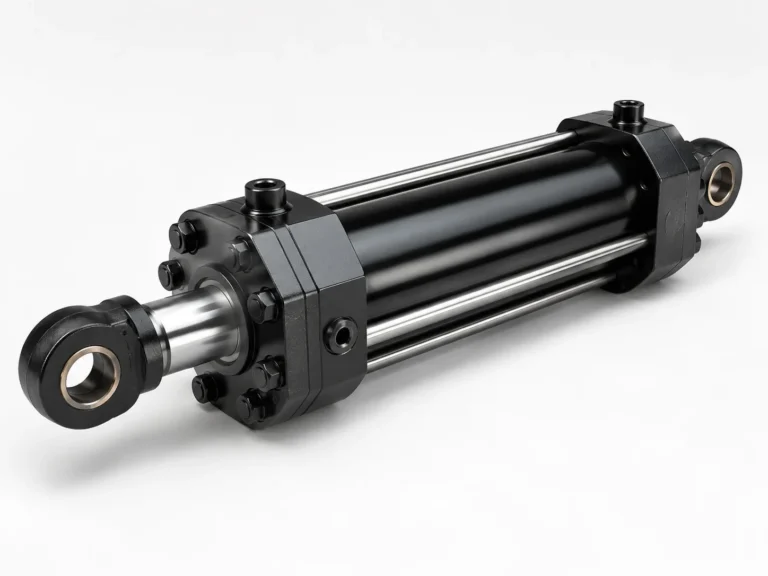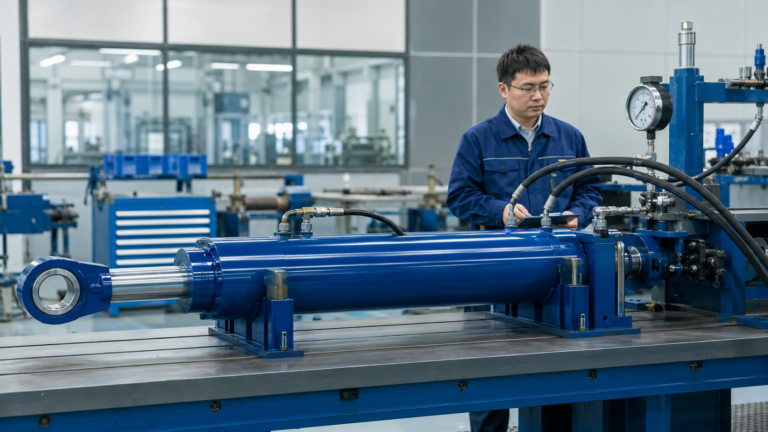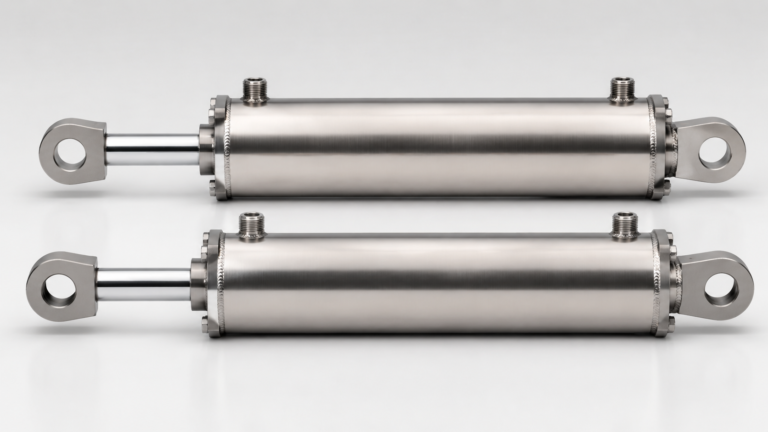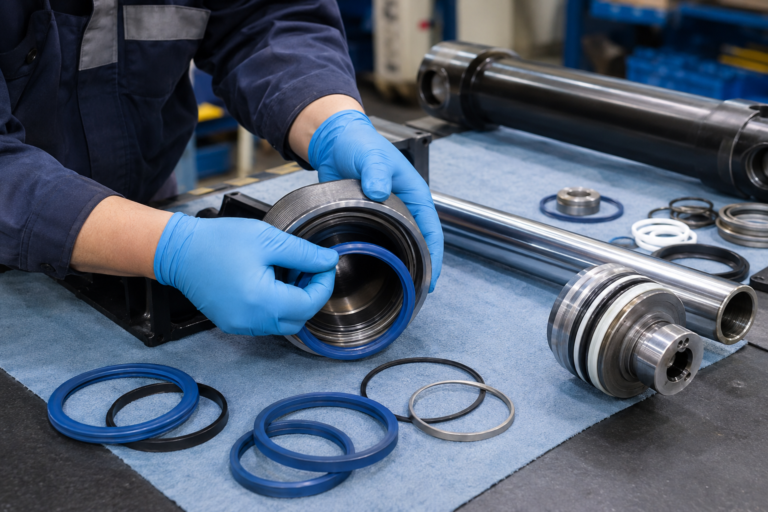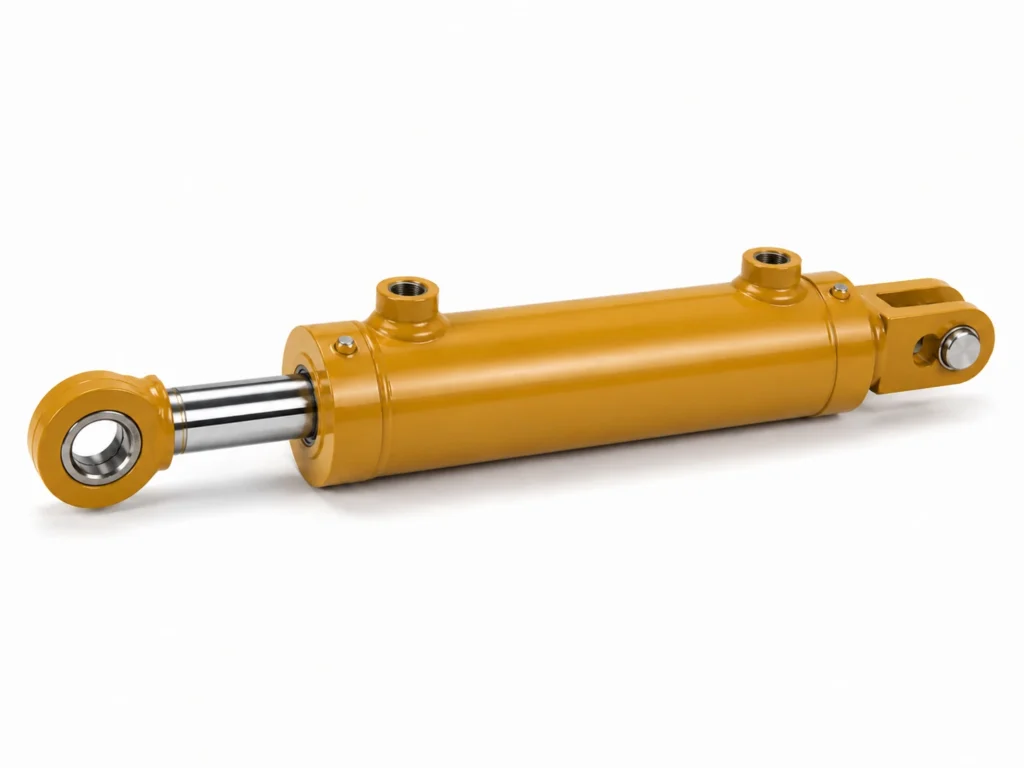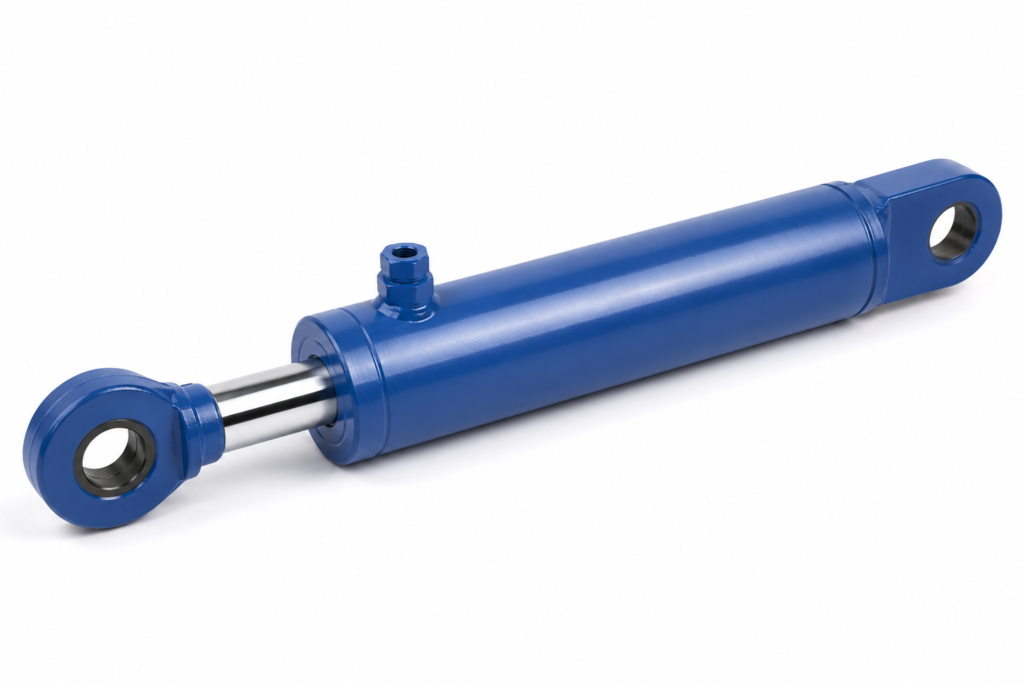
A hydraulic cylinder supplier audit is not a factory tour with a camera. It is a structured check of whether the supplier can repeatedly turn your drawing, duty cycle, and quality requirements into traceable cylinders that work after installation. You need evidence from engineering, materials, machining, welding, assembly, testing, and corrective-action records—not only a certificate and a polished workshop.
Quick Answer
To audit a hydraulic cylinder supplier, verify five things: the supplier understands your application, controls critical materials and dimensions, validates special processes such as welding, tests every required function, and can trace each cylinder back to inspection records. Start with a document review, follow one real order through the factory, sample records at each stage, and close the audit with evidence-based corrective actions.
Key Takeaways
- An ISO 9001 certificate shows a management system exists; it does not prove your cylinder or production lot is suitable.
- Audit a live job from drawing review to packing. Prepared demonstration parts can hide process gaps.
- Focus on bore, stroke, rod finish, seal grooves, weld integrity, port position, cleanliness, leakage, and function.
- Ask for records, not promises. A controlled process should leave traceable evidence.
- Approve conditionally through samples or a pilot order before committing annual volume.
What Is a Hydraulic Cylinder Supplier Audit?
A hydraulic cylinder supplier audit is a risk-based evaluation of a manufacturer’s ability to meet your technical, quality, capacity, and delivery requirements. Inspection tells you whether a sampled cylinder is acceptable today. An audit tells you whether the system is likely to produce acceptable cylinders next month and after volume increases.
A useful hydraulic cylinder supplier audit should answer three questions: Can the supplier understand and manufacture the cylinder you need? Can it repeat the result across batches? Can it detect, contain, and correct a problem before it reaches your line?
Hydraulic Cylinder Supplier Audit Scope
| Area | Evidence | Risk |
|---|---|---|
| Engineering | Approved drawings, calculations, revision control | Wrong design |
| Supply chain | Material certificates, approved sources, incoming checks | Unstable steel or seals |
| Manufacturing | Process sheets, capability, calibrated gauges | Dimensional variation |
| Special processes | Welding procedures, qualifications, NDT, coating control | Cracks or corrosion |
| Assembly and test | Clean assembly, controlled tests, traceable results | Early leakage |
Step 1: Prepare Before the Factory Visit
Send a short agenda and request documents in advance. Define the application, working and peak pressure, load direction, speed, duty cycle, temperature, fluid, contamination, corrosion exposure, mounting, acceptable leakage, and expected service life.
If you need a new design, verify the supplier’s process for custom hydraulic cylinder engineering. If you provide a complete drawing, focus on revision control, manufacturability review, and specification compliance. Use these custom cylinder specification questions to identify missing inputs before the hydraulic cylinder supplier audit.
Pre-audit document request
- Business license, organization chart, and factory address
- Quality certificates with scope, issuer, status, and expiry
- Equipment list and production flow
- Example drawing review and control plan
- Material and seal supplier controls
- Calibration list for critical measuring and test equipment
- Example inspection, pressure-test, and traceability records
- Recent corrective-action example with customer data removed
- Capacity, normal lead time, bottlenecks, and subcontracted processes
Step 2: Verify the Quality Management System
ISO 9001:2015 provides a framework for a quality management system. Certification is useful evidence of process discipline, but it is not product approval.
Check whether the legal company name, factory address, scope, certification body, and validity match the entity receiving your order. Then select one recent order and ask the team to show the drawing revision, incoming material record, in-process dimensions, test result, and shipment release.
Test revision control
Use a hypothetical change: the port moves from BSPP to SAE O-ring boss while stroke remains unchanged. Ask who reviews it, how the shop receives it, and how obsolete drawings are removed. An old drawing can produce a perfect cylinder that is perfectly wrong.
Step 3: Audit Engineering Capability
Engineering capability is not the number of CAD screens. Review how the team links required force to bore, evaluates rod buckling and side load, specifies tube and end construction, selects seals for fluid and temperature, checks cushioning and port flow, and confirms interfaces. When connection details are unclear, the hydraulic cylinder port thread guide shows which dimensions and standards should be verified.
Ask for a calculation or design-verification record for a comparable product. Confidential dimensions may be hidden; you are checking method, assumptions, approval, and connection to the released drawing. For common configurations, compare the explanation of double-acting cylinder design with your duty cycle.
Step 4: Trace Materials and Purchased Components
Select one material lot on the floor. Trace it backward to its certificate and forward to a production order. Confirm that material grade and condition match the drawing, heat or lot identity survives cutting, incoming inspection checks critical characteristics, and substitutions need technical approval.
Inspect seal storage. Seal kits should be identified by material and profile, kept clean, and protected from heat, light, deformation, and shelf-life problems. Ask what happens when the specified seal brand is unavailable. The correct response is controlled equivalence review and approval—not “we use something similar.”
Step 5: Inspect Machining and Dimensional Control
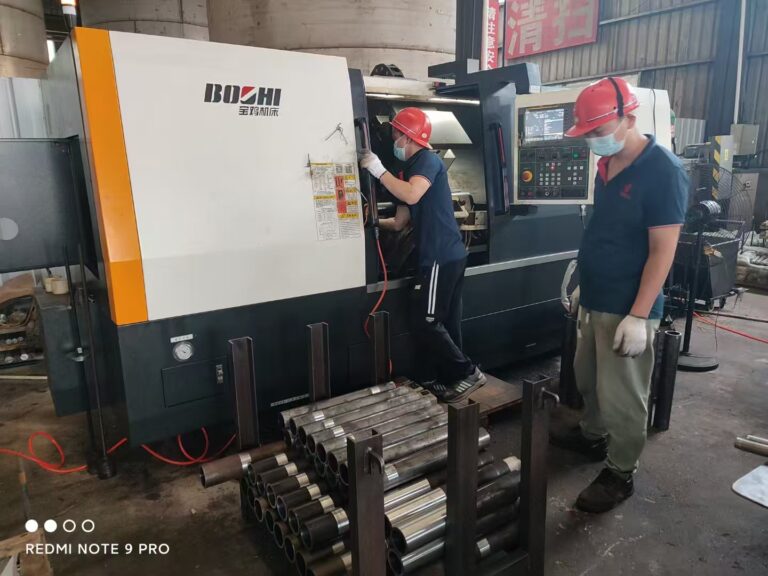
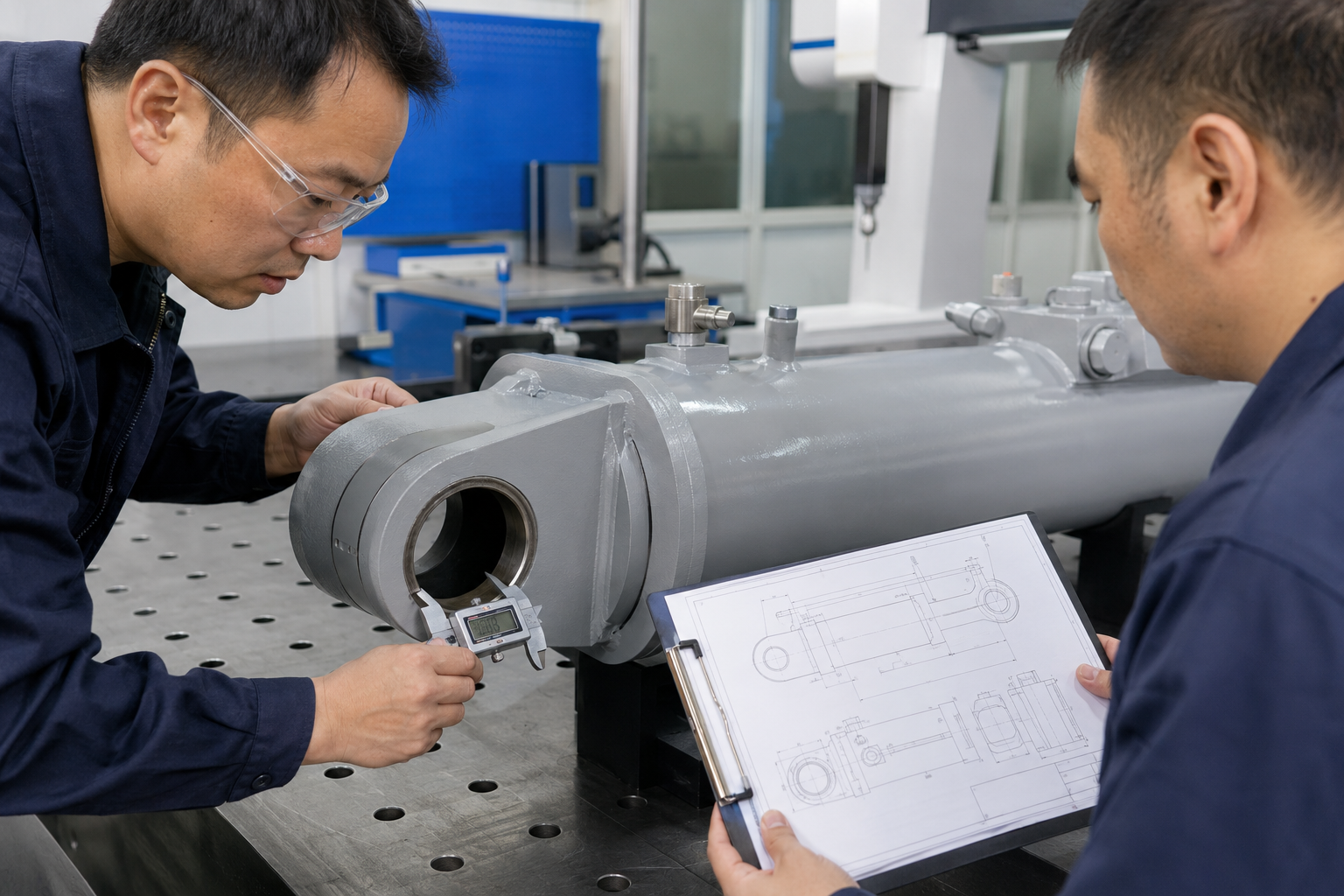
Walk cutting, turning, honing, milling, drilling, deburring, cleaning, and inspection. Judge whether critical characteristics are defined, measured, and controlled—not whether every machine is new.
- Bore diameter, straightness, roundness, and surface condition
- Rod diameter, straightness, surface finish, and coating thickness
- Seal and guide-ring groove dimensions
- Piston, gland, thread, and bearing fits
- Port thread, orientation, and position from datum
- Pin bore, alignment, mounting centers, and retracted length
Ask an inspector to measure one feature using the normal instruction. Check gauge identification and calibration. If the measurement system cannot resolve the tolerance, the inspection record gives false confidence.
Step 6: Audit Welding and Special Processes
Welding quality cannot be fully proven after the weld is finished. Process qualification matters, especially for welded hydraulic cylinders under shock, fatigue, or reversing loads.
- Are procedures defined for material, joint, filler, position, and parameters?
- Are welders qualified for their actual work?
- Are fit-up, preheat, interpass conditions, and distortion controlled where required?
- Are visual inspection and required NDT documented?
- Are repairs authorized, traceable, and re-inspected?
Apply the same logic to plating, hardening, heat treatment, painting, and corrosion testing. Outsourcing does not remove the cylinder supplier’s responsibility.
Step 7: Check Assembly and Cleanliness
A cylinder can pass machining inspection and fail early because a sharp edge cuts a seal or dirt enters during assembly. Components should be cleaned, capped, separated, and protected from welding and grinding debris.
Verify deburring, defined cleaning criteria, clean seal-installation tools, controlled lubrication, torque instructions, immediate port capping, and filtered test fluid. ISO 4406:2021 defines the coding method for solid-particle contamination. It does not set one universal cleanliness target for every cylinder; agree the required code based on system sensitivity and the customer specification.
Step 8: Witness Hydraulic Cylinder Testing
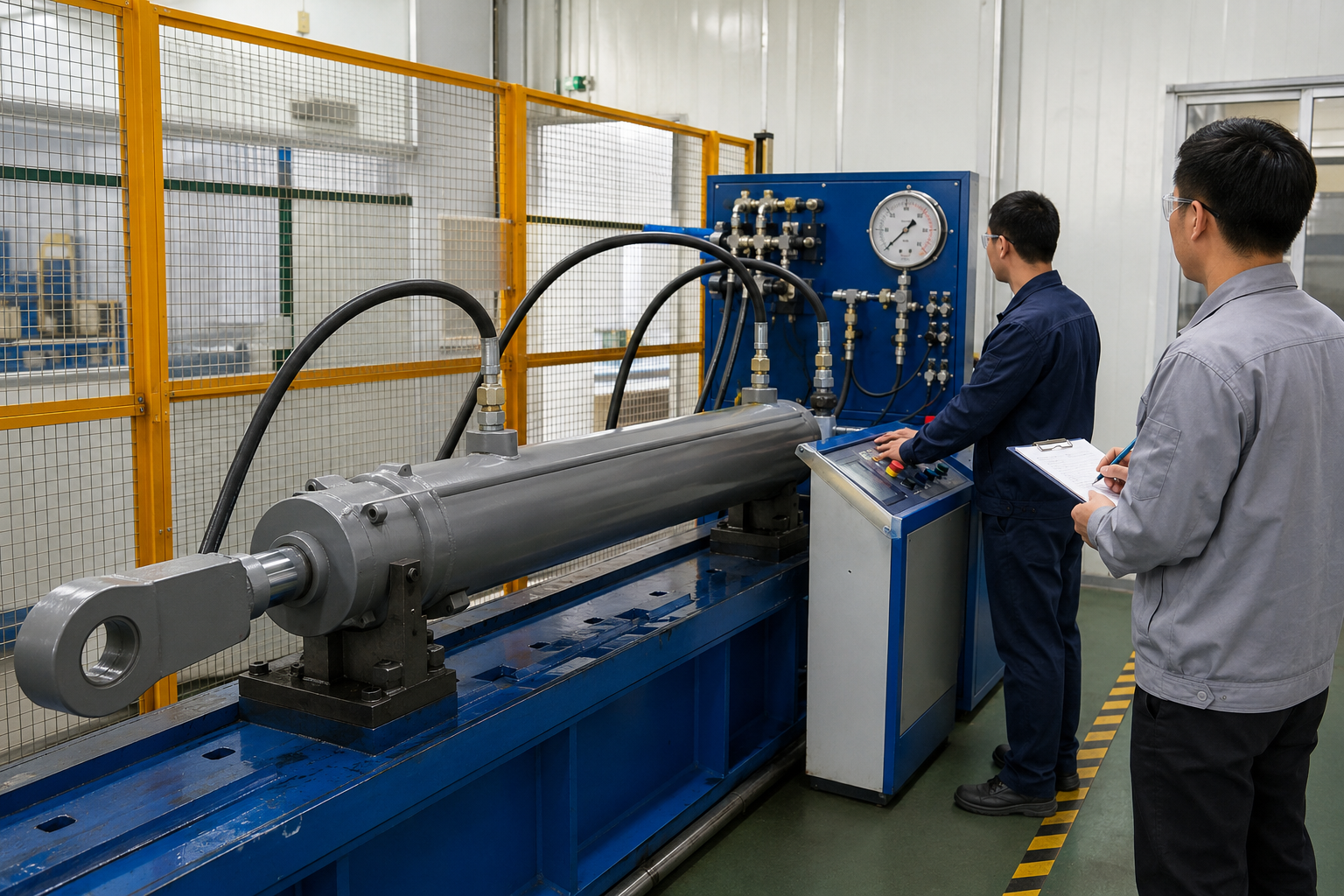
Witness a normal production cylinder, not only a prepared sample. ISO 10100:2020 specifies acceptance and function tests for hydraulic cylinders. Your purchase specification should still define pressure, hold time, leakage criteria, cycles, fluid, temperature, and records.
- Is the test procedure linked to part number and revision?
- Are gauges or transducers calibrated?
- Does testing include full-stroke function in required directions?
- Are leakage, bypass, noise, stick-slip, and cushions checked as applicable?
- Is proof pressure based on an approved requirement rather than habit?
- Are failures segregated, investigated, repaired under control, and retested?
- Can results be traced to serial or lot number?
Do not assume one proof-pressure ratio fits every design. The approved requirement must account for rating, materials, construction, seals, safety needs, and customer standards.
Step 9: Evaluate Capacity and Change Control
During the hydraulic cylinder supplier audit, compare claimed capacity with the bottleneck process. Honing, welding, plating, special seals, inspection, or testing may determine real output. Review loading, overtime dependence, maintenance, backup equipment, qualified operators, long-lead materials, and subcontractor lead times.
Define change notification. Steel grade, seal source, coating, process route, production site, drawing, and critical subcontractor should not change without the approval level stated in your agreement.
Step 10: Review Nonconformance and Corrective Action
Every real factory has quality problems. The question is how it reacts. Select a recent case and verify identification, segregation, disposition authority, affected-lot review, containment, root-cause analysis, corrective action, and effectiveness check.
“Operator retraining” alone is rarely a strong root cause. Look for changes to drawings, fixtures, process parameters, gauges, mistake-proofing, maintenance, or supplier controls.
Hydraulic Cylinder Supplier Audit Scorecard
| Category | Weight | Approval question |
|---|---|---|
| Engineering and review | 15% | Are application risks controlled? |
| Materials and supply chain | 15% | Are critical inputs verified and traceable? |
| Manufacturing control | 20% | Can the factory hold critical dimensions? |
| Special processes | 15% | Are qualifications and inspections matched to risk? |
| Assembly and testing | 20% | Does each required unit receive controlled verification? |
| Traceability and CAPA | 10% | Can problems be contained and prevented? |
| Capacity and delivery | 5% | Can promised volume survive disruption? |
A critical failure—fabricated records, uncontrolled design changes, no pressure-test capability, or untraceable material—can block approval even when the total score is acceptable.
Red Flags You Should Not Ignore
- The trading company, factory, invoice entity, and certificate holder cannot be connected.
- The supplier refuses to trace a random job or only shows prepared samples.
- Reports contain identical readings across many parts or missing instrument IDs.
- Old drawings remain uncontrolled on the shop floor.
- Material substitutions occur without engineering approval.
- Pressure testing has no written criteria or traceable results.
- Open assembly occurs beside grinding or welding.
- Rejected parts are not identified and segregated.
- The supplier promises every tolerance and delivery date without technical questions.
Common Audit Mistakes Buyers Make
Many audit gaps begin before the visit. Review these hydraulic cylinder purchasing mistakes so your audit checklist covers the decisions that commonly cause delays, leakage, and extra cost.
Scoring housekeeping above cylinder risk
A clean reception does not prove bore geometry, weld integrity, or leakage performance. Spend time where failure affects safety, downtime, and warranty cost.
Accepting certificates without records
Certificates describe a system. Records show whether people used it. Sample different dates, shifts, operators, and products.
Auditing the factory’s easiest product
Follow a cylinder comparable to yours in pressure, construction, size, material, and duty.
Approving mass production after one sample
A sample proves possibility. A pilot lot begins to prove repeatability. Use first-article approval and a controlled pilot order. Then monitor the causes of hydraulic cylinder failure after installation during field validation.
OEM Supplier Approval Checklist
- Approved drawing and specification revision
- Signed technical clarification and deviation list
- Control plan and inspection characteristics
- Material, seal, welding, cleanliness, and test requirements
- First article inspection report
- Traceability and record-retention requirements
- Packaging and corrosion-protection standard
- Change-notification agreement
- Corrective-action workflow
- Approved sample or pilot-lot result
How ZHY Hydraulic Supports Supplier Qualification
ZHY Hydraulic works with OEM buyers to convert drawings, samples, and application data into controlled manufacturing requirements. Our process covers technical review, material verification, CNC machining, welding, assembly, pressure testing, painting, inspection records, and export packing for OEM hydraulic cylinder solutions.
Before a pilot order, both teams can align the drawing revision, critical dimensions, seals, materials, test criteria, documentation, marking, and packaging. This gives the sample a clear acceptance baseline.
Qualifying a New Hydraulic Cylinder Supplier?
Upload your drawing and application requirements. ZHY Hydraulic can review manufacturability, identify missing technical inputs, and prepare a controlled quotation for a sample or pilot order.
FAQ
Is ISO 9001 enough to approve a hydraulic cylinder supplier?
No. It supports confidence in the quality system, but you still need product evidence from engineering, material control, manufacturing, testing, and traceability.
How long should a factory audit take?
A focused on-site audit often needs one full day. Complex products, multiple workshops, or outsourced special processes may require longer.
Should every hydraulic cylinder be pressure tested?
Your contract and risk assessment should define the plan. OEM buyers commonly require production cylinders to receive specified functional and leakage checks with traceable results.
What records should link to the serial number?
Depending on risk, link drawing revision, material lot, critical inspection, special processes, assembly, test result, and release status.
How can I audit a supplier without visiting China?
Use document review, a live process walkthrough, random job tracing, independent inspection, and a pilot order. Do not rely only on edited factory videos.
How should I compare two suppliers?
Use the same drawing, specification, evidence checklist, and scorecard. Compare technical risk, test evidence, delivery resilience, and lifecycle cost—not unit price alone.
Final Supplier Approval Recommendation
Approve a hydraulic cylinder supplier only when evidence matches the application risk. Review documents, audit one real production route, close critical findings, and use a first article or pilot lot to verify that the documented system produces acceptable cylinders.
The lowest quotation can become the highest-cost decision when leakage, wrong interfaces, inconsistent materials, late delivery, or field replacement enters the calculation. A strong audit makes those risks visible before they reach your customer.
Technical note: Standards and customer specifications can change. Confirm current editions and contractual requirements before final approval.